Griddle cooktop materials
This is the specification that decides what owning the griddle is like — and whether it can be brought back from neglect.

We earn a commission if you buy through our links, at no extra cost to you. That is how this site is paid for, and it does not decide what we recommend — full disclosure.
Quick picks
Ranked on published specifications using our scoring rubric. Tap a row for the full write-up.
| # | Product | Best for | Score | Price |
|---|---|---|---|---|
| 1 |  Blackstone 28" Original GriddleMost households Blackstone 28" Original GriddleMost households | Most households | 8.4 | Check price on Amazon |
| 2 | Weber Slate 30" GriddleOccasional cooks who hate rust | Occasional cooks who hate rust | 8.5 | Check price on Amazon |
| 3 |  Pit Boss Ultimate Lift-Off 4-Burner GriddleSkipping the seasoning routine entirely Pit Boss Ultimate Lift-Off 4-Burner GriddleSkipping the seasoning routine entirely | Skipping the seasoning routine entirely | 8.1 | Check price on Amazon |
| 4 |  Royal Gourmet PD1301 Portable GriddleThree zones under 30 pounds Royal Gourmet PD1301 Portable GriddleThree zones under 30 pounds | Three zones under 30 pounds | 7.6 | Check price on Amazon |
#ad We publish no prices: there is no verified price feed on this site, so the retailer’s page is the only price. How this is funded
Four materials, four different appliances
Cooking surface is the specification that changes ownership most and gets compared least. Two griddles with identical surface area and heat output can be completely different objects to live with depending on what the plate is made of.
Bare carbon steel
Blackstone, Traeger, Camp Chef, Nexgrill, Steelmade
The traditional surface and the best cooking one. Seasoned properly it becomes genuinely non-stick, develops fond that contributes real flavor, and sears harder than any coated surface because food bonds to it before you lift it.
Its superpower is reversibility. A bare steel top can be abraded back to clean metal and re-seasoned, indefinitely. A badly rusted one is an afternoon’s work and then it is as good as new — see rust removal. No other material here can do that.
Its weakness is that it demands a routine. Oil after every cook, a vented cover between cooks, and it will rust within weeks of neglect in a wet season.
Rust-resistant steel
Weber Slate
A treated steel surface that arrives pre-seasoned and resists corrosion in a way bare steel does not. Usable from the first cook with no seasoning session.
The trade is heat, and it is consistent: Weber’s Slate line sits at 45.5–66.7 BTU per square inch across its range, below the bare-steel competition at equivalent sizes.
Resistant is not proof. It still benefits from a cover and an oil wipe. What it buys is tolerance for the cook you forget — which, realistically, is most people.
Armored ceramic coating
Pit Boss Ultimate
Non-stick from the factory, no rust, no seasoning routine at all. For anyone who will not do maintenance, this deletes the entire problem.
The trade is lifespan. A coating is a wear item and cannot be restored. When it degrades the cooking surface is finished, whereas steel can be stripped back and rebuilt forever.
There is a cooking difference too: non-stick releases food rather than gripping it, which is excellent for eggs and delicate items and works against you for a smash-burger crust, which depends on the patty bonding hard before you lift it.
Porcelain enamel
Royal Gourmet
Glass fused to steel. No seasoning, no rust, easy to clean, and common on portable griddles where a maintenance routine is least likely to happen.
The specific failure mode is chipping. A chip exposes the steel beneath, and rust then creeps outward underneath the surrounding enamel where you cannot reach it. On a griddle that gets knocked around in a truck, that is a practical risk rather than a theoretical one.
Choosing
| If you | Buy |
|---|---|
| Cook weekly and will do the routine | Bare carbon steel |
| Cook occasionally, store it outside | Rust-resistant steel |
| Will not do a routine at all | Armored ceramic |
| Want a low-care portable | Porcelain enamel |
| Want maximum thermal mass | A thick steel insert |
And the thing that applies to all of them: thickness. Whatever the material, a thicker plate holds more heat and drops less when food lands. Heat density and thermal mass together.
The picks in detail
Specifications are linked to their source on every card. Scores are ours, derived from those specifications.
#1 · Most households
Blackstone 28" Original Griddle
The size most people should actually buy: 525 square inches and two zones covers a family of four with headroom, on a footprint that fits a normal patio.
#ad We publish no prices: there is no verified price feed on this site, so the retailer’s page is the only price. How this is funded
Key specifications
- Cooking area
- 525 sq in (28¾ × 18¼ in)
- Burners
- 2, stainless H-burners
- Total output
- 34,000 BTU
- Cooktop
- 10-gauge rolled carbon steel
- Ignition
- Piezo
- Zones
- 2, independently controlled
Specifications from BBQGuys spec sheet.
Scores
- Cooking area7.5
- Heat output7.0
- Zone control7.0
- Surface care6.5
- Portability5.0
What works
- The 10-gauge plate is thicker than most griddles at this size, which is what keeps temperature steady when cold food hits it
- Two zones is genuinely enough: one hot side for searing, one moderate side for holding
- Fits a standard patio and a standard cover, which the 36 often does not
What to know
- Only two zones — you cannot run a dedicated warming zone and two cooking temperatures at once
- 34,000 BTU over 525 sq in is modest heat density; recovery after a big load is slower than the 36
- Bare carbon steel needs seasoning and a cover, same as every Blackstone
#2 · Occasional cooks who hate rust
Weber Slate 30" Griddle
Three zones over 540 square inches on a rust-resistant top — the best griddle here for someone who cooks once a fortnight and does not want to fight their surface.
#ad We publish no prices: there is no verified price feed on this site, so the retailer’s page is the only price. How this is funded
Key specifications
- Cooking area
- 540 sq in
- Burners
- 3, stainless steel
- Total output
- 36,000 BTU
- Cooktop
- Rust-resistant carbon steel, pre-seasoned
- Dimensions
- 70.80 W × 39.50 H × 23.50 D in
- Weight
- 140.34 lb
Specifications from P.C. Richard spec sheet.
Scores
- Cooking area7.5
- Heat output7.0
- Zone control8.5
- Surface care9.5
- Portability4.0
What works
- Three zones at 540 sq in beats the Blackstone 28's two zones at 525 sq in — more control for the same footprint
- Rust resistance is the difference between a griddle that survives a wet autumn and one that does not
- Four swivel casters, so it actually moves on a patio
What to know
- 140 lb means 'moves on a patio', not 'goes in the truck'
- 66.7 BTU per sq in is middling — fine for everyday cooking, slower than the Traeger for a heavy sear
- The rust-resistant coating is not invincible; it still wants a cover
#3 · Skipping the seasoning routine entirely
Pit Boss Ultimate Lift-Off 4-Burner Griddle
The only griddle here with a non-stick armored ceramic surface rather than steel — no seasoning, no rust, and a different set of trade-offs.
#ad We publish no prices: there is no verified price feed on this site, so the retailer’s page is the only price. How this is funded
Key specifications
- Cooking area
- 647 sq in
- Burners
- 4, stainless steel
- Total output
- 46,000 BTU
- Cooktop
- Non-stick armored ceramic
- Lift-off top
- 89 lb
- Grease
- Removable tray
Specifications from Pit Boss product page.
Scores
- Cooking area8.5
- Heat output8.0
- Zone control9.5
- Surface care8.0
- Portability3.0
What works
- No seasoning and no rust — this is a genuinely different ownership experience from every steel top here
- Four zones across 647 sq in, and the top lifts off for cleaning
- Folding shelves with built-in tool hooks
What to know
- A ceramic coating is a wear item — steel can be restored indefinitely, a coating cannot
- The lift-off top weighs 89 lb; 'removable for cleaning' is a two-person job
- Non-stick surfaces do not develop the fond that makes a seasoned steel top sear the way it does
#4 · Three zones under 30 pounds
Royal Gourmet PD1301 Portable Griddle
Three separately controlled burners over 319 square inches at 29.3 lb — more zone control than any other truly portable griddle here.
#ad We publish no prices: there is no verified price feed on this site, so the retailer’s page is the only price. How this is funded
Key specifications
- Cooking area
- 319 sq in (23.82 × 13.39 in)
- Burners
- 3, separately controlled
- Total output
- 25,500 BTU
- Cooktop
- 3.5 mm porcelain-enamelled steel
- Weight
- 29.3 lb
- Dimensions
- 26.69 × 16.14 × 7.87 in
Specifications from Home Depot listing.
Scores
- Cooking area4.5
- Heat output7.5
- Zone control8.0
- Surface care7.5
- Portability8.5
What works
- Three zones in a 29 lb tabletop is genuinely unusual
- 79.9 BTU per square inch — the highest density of any portable here
- Porcelain enamel means no seasoning routine on a griddle that lives in a garage
What to know
- Porcelain enamel chips, and a chipped enamel top rusts from the chip outward
- 319 sq in is small once you are cooking for more than three
- Lighter build than the Blackstone or Weber tabletops
Common questions
What is the best griddle cooking surface?
Are ceramic griddle surfaces safe and durable?
Is rust-resistant steel worth the lower heat?
What goes wrong with porcelain enamel griddle tops?
Sources
Every specification on this page came from one of these. If you find one of them has changed, tell us and we will correct it.
Read next
Seasoning a griddle for the first time
The complete first-seasoning process step by step, the three ways it goes wrong, and what a correct result actually looks like.

How to remove rust from a griddle
The complete rust removal process for a steel cooktop, how far to abrade, and the debris step most people skip.
Blackstone vs Pit Boss
Blackstone's steel and ecosystem against Pit Boss's two options: the highest heat density here, or no maintenance at all.
Griddle BTU, explained
Why total BTU is close to meaningless, how heat density reorders the category, and which griddles actually recover under load.
The best flat-top griddles
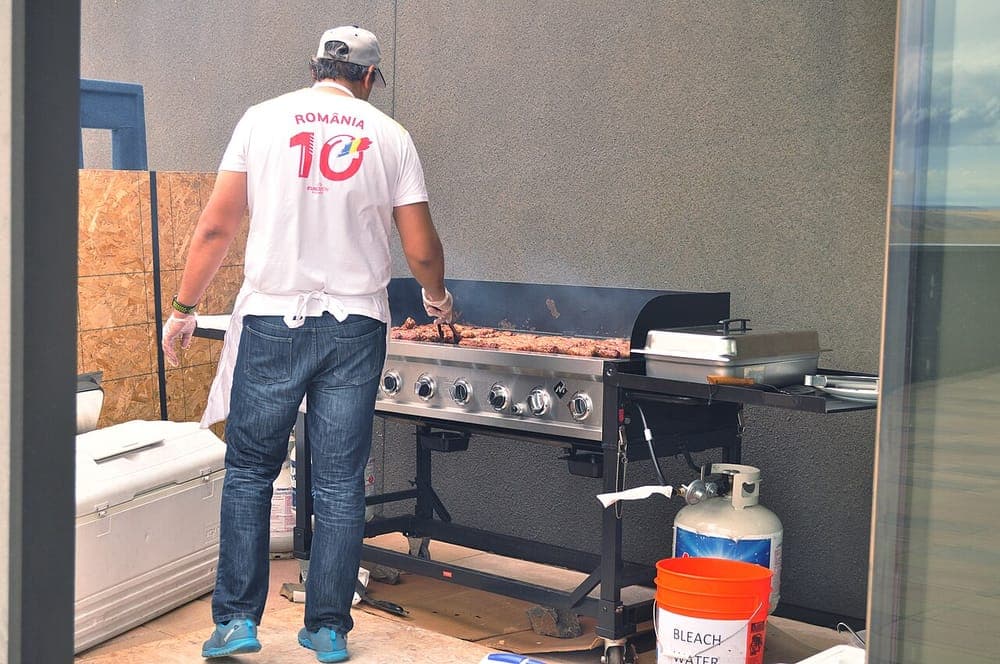
Our flagship ranking. Every major flat-top griddle scored on cooking area, burner count, heat density and cooktop material.
How to stop a griddle rusting
The oil-and-cover routine, why vents matter more than people think, and how to store a griddle over a wet season.