2-burner vs 4-burner griddles
Adding burners does not add heat density. It adds simultaneous temperatures, which is a different thing entirely.
We earn a commission if you buy through our links, at no extra cost to you. That is how this site is paid for, and it does not decide what we recommend — full disclosure.
Quick picks
Ranked on published specifications using our scoring rubric. Tap a row for the full write-up.
| # | Product | Best for | Score | Price |
|---|---|---|---|---|
| 1 |  Traeger Flatrock 2-Zone GriddleSmall-space searing Traeger Flatrock 2-Zone GriddleSmall-space searing | Small-space searing | 8.2 | Check price on Amazon |
| 2 |  Blackstone 28" Original GriddleMost households Blackstone 28" Original GriddleMost households | Most households | 8.4 | Check price on Amazon |
| 3 | 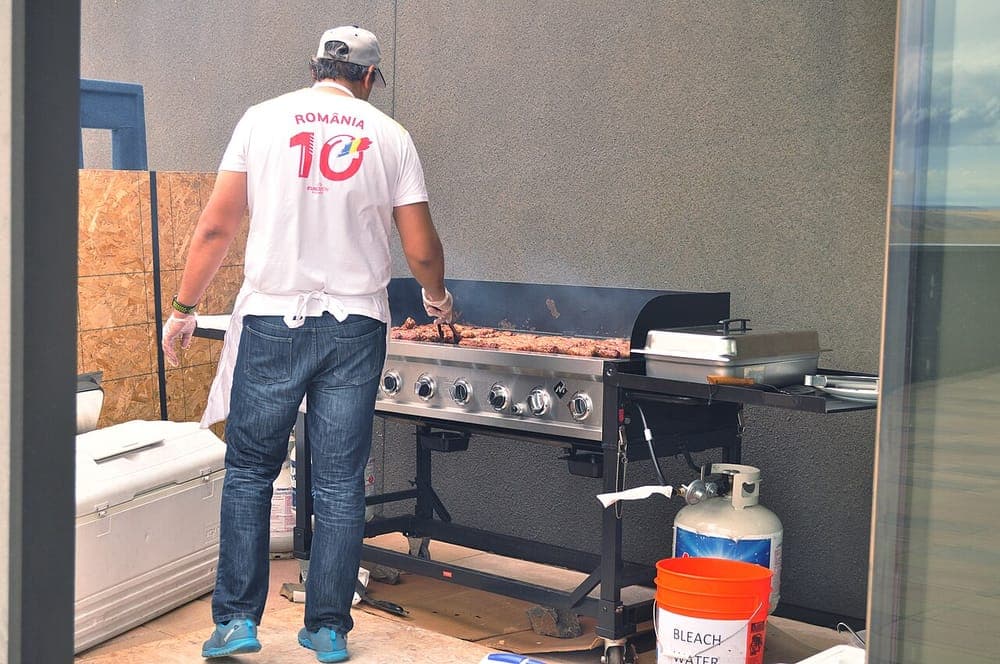 Blackstone 36" Original GriddleLarge families and crowd cooking Blackstone 36" Original GriddleLarge families and crowd cooking | Large families and crowd cooking | 8.6 | Check price on Amazon |
| 4 | Pit Boss Deluxe 4-Burner GriddleRaw heat per square inch | Raw heat per square inch | 8.5 | Check price on Amazon |
#ad We publish no prices: there is no verified price feed on this site, so the retailer’s page is the only price. How this is funded
The misconception to clear first
More burners does not mean a hotter griddle. Manufacturers add burners as they add surface area, so heat density stays roughly constant.
The proof is in our own numbers: the two-burner Traeger Flatrock 2-Zone runs 76.9 BTU per square inch, and the four-burner Weber Slate 36 runs 63.5. The two-burner griddle has 21% more heat per square inch than the four-burner one.
What burners buy is simultaneous temperatures. The arithmetic in full.
What two zones lets you cook
A hot end and a moderate end. In practice:
- Sear patties hot, slide across to hold while buns toast on the same moderate zone.
- Bacon on the hot end, eggs on the moderate end.
- Hard-sear a steak, then move it across to come up to temperature gently.
That covers the large majority of domestic cooking for four people or fewer. Two zones is the threshold at which a griddle becomes a griddle.
What four zones adds
A dedicated holding zone that is not costing you a cooking temperature, plus a spare.
Concretely: sear at 500 °F, cook at 400 °F, toast and sweat at 325 °F, and hold at 225 °F, all at once. That turns the griddle from a cooking surface into a staging surface, which is what multi-component meals and crowd cooking actually need.
With two zones, holding costs you one of your two cooking temperatures and you have to choose.
The caveat nobody mentions: zones blur
Steel conducts heat sideways. On almost every griddle, four “independent” zones under one continuous plate gradually equalize — and the longer the cook, the worse it gets.
Which means the extra zones are least reliable during exactly the long multi-wave cooks you bought them for. Traeger’s insulated zones are the only direct engineering answer in our guide; on everything else, leave the burner next to your holding zone unlit where you can.
The honest test
Four burners only pay for themselves if you use the zones differently. A four-burner griddle run with everything on high is a large single-zone griddle with a higher gas bill.
If your cooking is one protein at a time for four people, two zones is the right purchase and the money is better spent on a cover and decent spatulas.
Three is the underrated answer
Three zones gives you a holding area on top of two cooking temperatures — the main benefit of four — without the footprint. The Weber Slate 30 delivers it at a 28-inch footprint, and the Traeger Flatrock 3-Zone delivers it with insulation. For most households that is the sweet spot.
The picks in detail
Specifications are linked to their source on every card. Scores are ours, derived from those specifications.
#1 · Small-space searing
Traeger Flatrock 2-Zone Griddle
468 square inches at 76.9 BTU per square inch — less surface than a Blackstone 28 but considerably more heat behind it.
#ad We publish no prices: there is no verified price feed on this site, so the retailer’s page is the only price. How this is funded
Key specifications
- Cooking area
- 468 sq in (cooktop 26 × 18 in)
- Burners
- 2 (insulated zones)
- Total output
- 36,000 BTU
- Cooktop
- Carbon steel
- Zones
- 2, insulated
- Format
- Cart
Specifications from Abt spec sheet.
Scores
- Cooking area6.5
- Heat output9.0
- Zone control7.5
- Surface care6.5
- Portability5.0
What works
- Same 36,000 BTU as a Weber Slate 30 across 72 fewer square inches — it sears noticeably harder
- Insulated zone separation in a two-burner body, which rivals do not offer
- A genuinely small footprint for a cart griddle
What to know
- 468 sq in is tight for more than four people
- Two zones only — no dedicated holding area
- Carbon steel maintenance, like the 3-zone
#2 · Most households
Blackstone 28" Original Griddle
The size most people should actually buy: 525 square inches and two zones covers a family of four with headroom, on a footprint that fits a normal patio.
#ad We publish no prices: there is no verified price feed on this site, so the retailer’s page is the only price. How this is funded
Key specifications
- Cooking area
- 525 sq in (28¾ × 18¼ in)
- Burners
- 2, stainless H-burners
- Total output
- 34,000 BTU
- Cooktop
- 10-gauge rolled carbon steel
- Ignition
- Piezo
- Zones
- 2, independently controlled
Specifications from BBQGuys spec sheet.
Scores
- Cooking area7.5
- Heat output7.0
- Zone control7.0
- Surface care6.5
- Portability5.0
What works
- The 10-gauge plate is thicker than most griddles at this size, which is what keeps temperature steady when cold food hits it
- Two zones is genuinely enough: one hot side for searing, one moderate side for holding
- Fits a standard patio and a standard cover, which the 36 often does not
What to know
- Only two zones — you cannot run a dedicated warming zone and two cooking temperatures at once
- 34,000 BTU over 525 sq in is modest heat density; recovery after a big load is slower than the 36
- Bare carbon steel needs seasoning and a cover, same as every Blackstone
#3 · Large families and crowd cooking
Blackstone 36" Original Griddle
The default large griddle: four burners over 769 square inches, with the highest burner count in its size class and the deepest accessory ecosystem of any brand here.
#ad We publish no prices: there is no verified price feed on this site, so the retailer’s page is the only price. How this is funded
Key specifications
- Cooking area
- 769 sq in (35¾ × 21½ in)
- Burners
- 4, stainless steel
- Total output
- 60,000 BTU
- Cooktop
- Carbon steel
- Ignition
- Single spark
- Grease system
- Rear
Specifications from BBQGuys spec sheet.
Scores
- Cooking area9.5
- Heat output9.0
- Zone control9.5
- Surface care6.5
- Portability3.0
What works
- Four independent zones is the real argument for this size — you can hold a warm zone and still sear
- 769 sq in is enough to cook a full breakfast for eight without staging
- The widest accessory and spare-parts availability of any brand in this guide
What to know
- Bare carbon steel: it will rust if you leave it uncovered and unseasoned
- Needs real patio footprint — this is not a griddle you put away each week
- Rear grease management means the drain is behind the unit, which is awkward against a wall
#4 · Raw heat per square inch
Pit Boss Deluxe 4-Burner Griddle
62,000 BTU across 753 square inches — 82.3 BTU per square inch, the highest heat density of any griddle in this guide.
#ad We publish no prices: there is no verified price feed on this site, so the retailer’s page is the only price. How this is funded
Key specifications
- Cooking area
- 753 sq in (top 37 × 20 in)
- Burners
- 4, separately controlled stainless
- Total output
- 62,000 BTU
- Cooktop
- 4.7 mm steel, pre-seasoned with organic oil
- Portability
- Fold-and-go
- Includes
- Side shelves and lid
Specifications from Pit Boss product page.
Listings disagree: Sold as 753 sq in (model 10963) and 748 sq in (model 10942), both at 62,000 BTU.
Scores
- Cooking area9.5
- Heat output10.0
- Zone control9.5
- Surface care7.0
- Portability4.5
What works
- 82.3 BTU per square inch is the highest here — it recovers fastest when a full load of cold food goes down
- A 4.7 mm plate is thick for this price class, which is what buys you stable temperature
- Pre-seasoned with organic oil, so it is usable sooner than a bare plate
What to know
- Fold-and-go legs are less stable than a fixed cart under a loaded 753 sq in top
- The sibling SKU is listed at 748 sq in with a slightly different top — check which you are buying
- Still a steel top: seasoning and covering are on you
Common questions
Does a 4-burner griddle get hotter than a 2-burner?
When is a 4-burner griddle worth it?
Is two burners enough?
Is three burners a good compromise?
Sources
Every specification on this page came from one of these. If you find one of them has changed, tell us and we will correct it.
Read next
How many burners do you need?
What one, two, three and four zones actually buy you, why insulation matters, and the picks at each burner count.
The best 2-burner griddles
Two-burner griddles compared. Where two zones is genuinely enough, and the one spec that separates these five.
The best 4-burner griddles
Four-burner griddles compared. What the fourth zone actually buys, and the 29% heat-density spread hiding inside this class.
Griddle BTU, explained
Why total BTU is close to meaningless, how heat density reorders the category, and which griddles actually recover under load.

Griddle cooking for a crowd
How to plan and run a wave-based griddle cook for a crowd, and why the holding zone matters more than surface area.
What size griddle do I need?
Square inches per person, what each size class holds in practice, and the picks for each — plus why the 36 is usually a mistake.