Blackstone vs Traeger Flatrock
Same heat density, 175 square inches apart, and only one of them stops heat bleeding between zones.

We earn a commission if you buy through our links, at no extra cost to you. That is how this site is paid for, and it does not decide what we recommend — full disclosure.
Quick picks
Ranked on published specifications using our scoring rubric. Tap a row for the full write-up.
| # | Product | Best for | Score | Price |
|---|---|---|---|---|
| 1 | Traeger Flatrock 3-Zone GriddleSearing and zone discipline | Searing and zone discipline | 8.8 | Check price on Amazon |
| 2 | 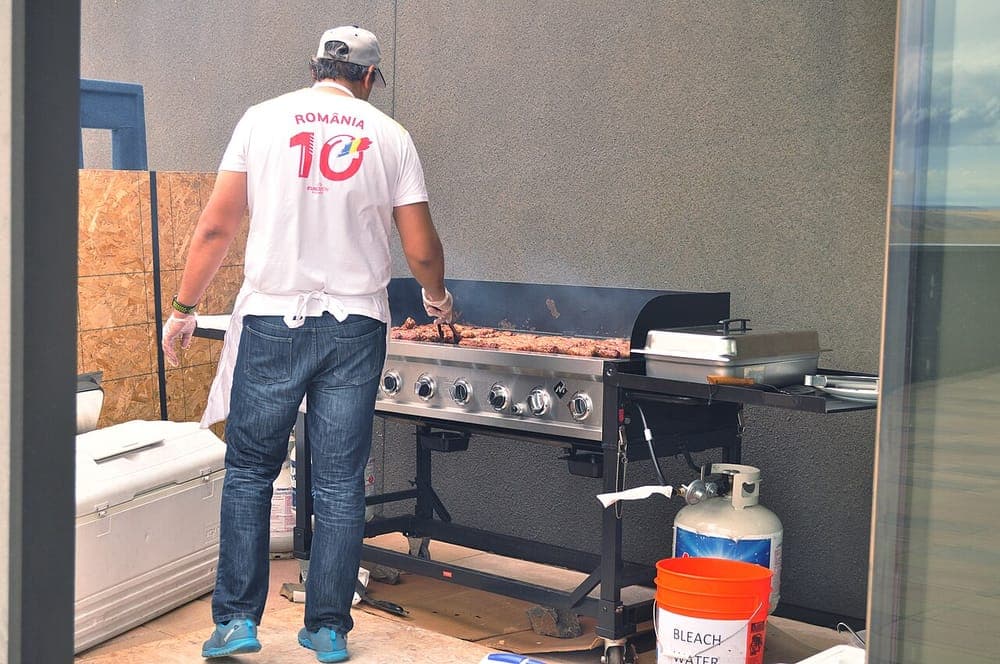 Blackstone 36" Original GriddleLarge families and crowd cooking Blackstone 36" Original GriddleLarge families and crowd cooking | Large families and crowd cooking | 8.6 | Check price on Amazon |
#ad We publish no prices: there is no verified price feed on this site, so the retailer’s page is the only price. How this is funded
Side by side
Same fields on both sides. Heat density is computed from the published BTU and cooking area, not quoted from a manufacturer.
| Specification | Traeger Flatrock 3-Zone Griddle | Blackstone 36" Original Griddle |
|---|---|---|
| Cooking area | 594 sq in | 769 sq in |
| Burners | 3 | 4 |
| Total output | 47,000 BTU | 60,000 BTU |
| Heat density | 79.1 BTU / sq in | 78 BTU / sq in |
| Cooktop | Carbon steel | Carbon steel |
| Best for | Searing and zone discipline | Large families and crowd cooking |
| Our score | 8.8 / 10 | 8.6 / 10 |
Heat density is a tie
79.1 against 78.0 BTU per square inch is, for practical purposes, identical. Both of these recover well under load, and both will sear properly.
Which is useful, because it means this comparison is not about power at all. It is about two genuinely different design priorities.
Traeger’s argument: zones that stay separate
On the Blackstone — and on essentially every other griddle — the burners sit under one continuous steel plate. Steel conducts heat extremely well, so heat bleeds sideways. Your holding zone drifts hotter as the cook goes on, and food parked there keeps cooking.
Traeger insulates between its three zones. A holding zone set low stays low while the zone next to it runs hot, for the whole cook.
The counter-intuitive part: this matters more during long multi-wave cooks — which is exactly the scenario people buy a 36-inch griddle for. So Traeger’s feature partly addresses the problem Blackstone’s extra surface is meant to solve.
Blackstone’s argument: 175 square inches
769 against 594 is not a marginal difference. It is roughly one and a half additional zones worth of cooking space, and it is the difference between cooking for eight in one pass and cooking for eight in waves.
A fourth zone also means a genuinely spare zone — sear, two working temperatures and a holding area, with capacity left over. At scale that is what matters.
The temperature floor
A real quirk worth knowing: Traeger states a range of 350–600 °F. The bottom of that is a cooking temperature, not a holding temperature.
Which is odd given that the insulated holding zone is the headline feature — the zones stay separate, but the lowest one is still 350 °F. If very gentle holding matters to you, neither of these is ideal and an electric griddle with a true warm setting does it better.
Everything else
Both are bare carbon steel, so the seasoning and covering routine is identical — see Blackstone and Traeger.
Blackstone has far better parts and accessory availability. Traeger is also physically large for its cooking area — 74 inches wide for 594 square inches, because the insulated zone construction and side tables cost footprint. Measure before buying.
Which to buy
Traeger Flatrock 3-Zone if you cook composed meals for four to six and care about control. It is the better cooking instrument and tops our overall ranking.
Blackstone 36 if you cook volume, need four zones, or want the parts ecosystem. It is the better griddle for feeding people.
If you want Traeger’s approach in a smaller body, the 2-Zone keeps the insulation at 468 square inches.
The picks in detail
Specifications are linked to their source on every card. Scores are ours, derived from those specifications.
#1 · Searing and zone discipline
Traeger Flatrock 3-Zone Griddle
594 square inches with three insulated zones and 79.1 BTU per square inch — the highest usable heat density of any mid-size griddle here.
#ad We publish no prices: there is no verified price feed on this site, so the retailer’s page is the only price. How this is funded
Key specifications
- Cooking area
- 594 sq in
- Burners
- 3 (TruZone, insulated)
- Total output
- 47,000 BTU
- Cooktop
- Carbon steel
- Stated range
- 350–600 °F
- Dimensions
- 74 W × 42 H × 27 D in
Specifications from Abt spec sheet.
Scores
- Cooking area8.0
- Heat output9.5
- Zone control9.5
- Surface care6.5
- Portability3.5
What works
- Insulated zones are the real feature — heat does not bleed sideways, so a 'warm' zone stays warm
- 79.1 BTU per sq in is the best heat density in its size class, which is what you feel when six patties hit the plate
- Three genuinely independent zones in a body smaller than a 36
What to know
- Carbon steel, so you are back to seasoning and covering it
- The stated 350–600 °F range is narrower at the bottom than rivals — gentle holding is less controllable
- Smallest accessory ecosystem of the four major brands
#2 · Large families and crowd cooking
Blackstone 36" Original Griddle
The default large griddle: four burners over 769 square inches, with the highest burner count in its size class and the deepest accessory ecosystem of any brand here.
#ad We publish no prices: there is no verified price feed on this site, so the retailer’s page is the only price. How this is funded
Key specifications
- Cooking area
- 769 sq in (35¾ × 21½ in)
- Burners
- 4, stainless steel
- Total output
- 60,000 BTU
- Cooktop
- Carbon steel
- Ignition
- Single spark
- Grease system
- Rear
Specifications from BBQGuys spec sheet.
Scores
- Cooking area9.5
- Heat output9.0
- Zone control9.5
- Surface care6.5
- Portability3.0
What works
- Four independent zones is the real argument for this size — you can hold a warm zone and still sear
- 769 sq in is enough to cook a full breakfast for eight without staging
- The widest accessory and spare-parts availability of any brand in this guide
What to know
- Bare carbon steel: it will rust if you leave it uncovered and unseasoned
- Needs real patio footprint — this is not a griddle you put away each week
- Rear grease management means the drain is behind the unit, which is awkward against a wall
Common questions
Is the Traeger Flatrock better than a Blackstone?
What does insulated zone separation actually do?
Do Blackstone and Traeger have similar heat?
Sources
Every specification on this page came from one of these. If you find one of them has changed, tell us and we will correct it.
Read next
Traeger Flatrock 3-Zone
594 square inches, three insulated zones, 79.1 BTU per square inch. The best heat-and-control combination in the guide.
Blackstone 36" Original
769 square inches, four burners, 60,000 BTU. The large-griddle default — and an honest look at who actually needs it.

Weber Slate vs Traeger Flatrock
Weber's rust-resistant top and three zones against Traeger's insulated zones and higher heat density.
How many burners do you need?
What one, two, three and four zones actually buy you, why insulation matters, and the picks at each burner count.
The best flat-top griddles
Our flagship ranking. Every major flat-top griddle scored on cooking area, burner count, heat density and cooktop material.
Traeger Flatrock 2-Zone
468 square inches, two insulated zones, 76.9 BTU per square inch. Small footprint, serious searing.