Griddle cooking for a crowd
Past six people the constraint stops being heat and becomes where the cooked food waits.

We earn a commission if you buy through our links, at no extra cost to you. That is how this site is paid for, and it does not decide what we recommend — full disclosure.
Quick picks
Ranked on published specifications using our scoring rubric. Tap a row for the full write-up.
| # | Product | Best for | Score | Price |
|---|---|---|---|---|
| 1 |  Grease Cup LinersThe chore nobody wants to do Grease Cup LinersThe chore nobody wants to do | The chore nobody wants to do | 8.2 | Check price on Amazon |
| 2 |  Griddle Spatula PairThe two tools you actually use Griddle Spatula PairThe two tools you actually use | The two tools you actually use | 8.7 | Check price on Amazon |
| 3 |  Melting DomeCheese, and steaming anything Melting DomeCheese, and steaming anything | Cheese, and steaming anything | 8.4 | Check price on Amazon |
| 4 | 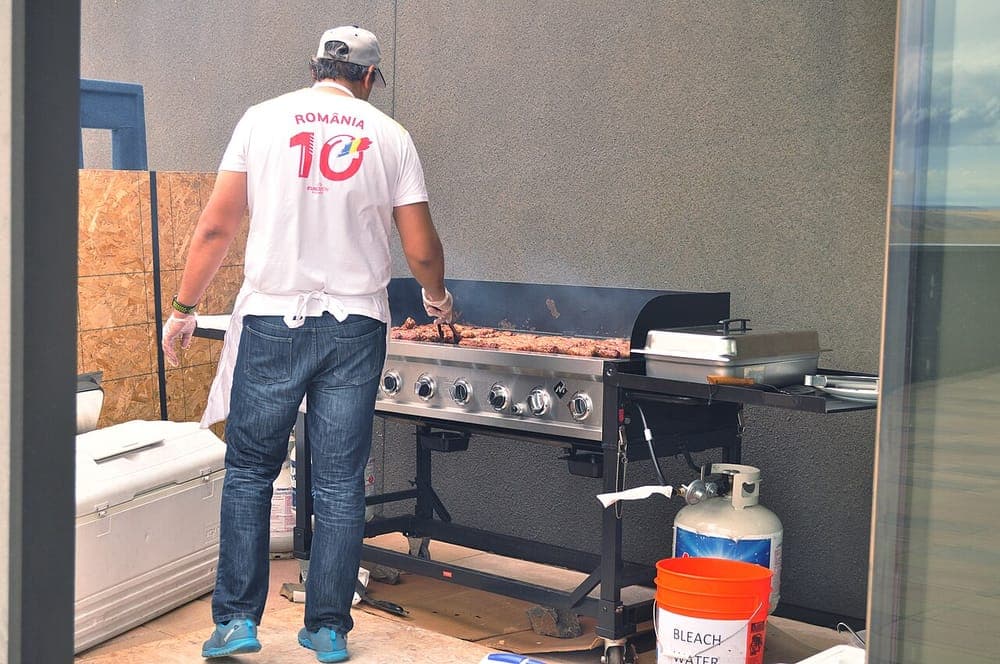 Blackstone 36" Original GriddleLarge families and crowd cooking Blackstone 36" Original GriddleLarge families and crowd cooking | Large families and crowd cooking | 8.6 | Check price on Amazon |
#ad We publish no prices: there is no verified price feed on this site, so the retailer’s page is the only price. How this is funded
The constraint changes
Up to four or five people, a griddle cook is one pass: everything goes on, everything comes off, everyone eats. Surface area is the binding constraint.
Past about six, you cannot fit the meal on any domestic griddle at once. The cook becomes a sequence of waves, and the question becomes: where does the cooked food wait?
That is a staging problem, not a heat problem, and it changes almost everything about how you plan.
The holding zone is now the most important zone
200–250 °F. Above food-safe holding temperature, below cooking temperature. Food parked there stays at serving temperature indefinitely without continuing to cook.
Without one you either serve in waves — some people eating while others wait — or pile cooked food somewhere and serve it lukewarm.
This is why burner count matters more at scale than surface area does. Four zones lets you hold, run two cooking temperatures and still sear. Two zones means holding costs you one of your two cooking temperatures.
Plan in waves
- Count the waves before you start. Twenty burgers on a 36-inch griddle is two waves, not one. Knowing that in advance changes the order you cook in.
- Longest-cooking items first. They go to the holding zone and wait.
- Fastest items last, so they arrive fresh.
- Prep everything before lighting the griddle. There is no time to chop onions once a wave is down.
- Lay out raw food in cook order on your side shelves. Mid-wave is the wrong moment to be hunting for the next tray.
Recovery is the hidden cost
Every wave puts a full load of cold food onto the plate at once — the hardest thing you can ask a griddle to do. Heat density determines how fast the surface comes back, and in wave cooking you pay that cost repeatedly rather than once.
Two practical consequences:
- Give the plate thirty seconds between waves rather than loading immediately.
- Do not fill every square inch. A plate loaded to capacity recovers slowest; leaving room helps more than it costs.
The practicalities that bite at scale
- Propane. Four burners at 60,000 BTU for an hour is real consumption. Keep a second tank — running out mid-wave is worse than running out at all.
- Grease volume. You will fill the cup. This is where liners stop being a convenience, and check the cup between waves rather than after.
- Prep space. Raw and cooked food both need somewhere to go. Side shelves and a folding table beside the griddle matter more than you expect.
- Cleaning. 769 square inches is a lot of plate to scrape. The hot-scrape routine matters more here, because the cold-plate version takes three times as long.
Worked example: burgers for twenty
On a four-zone 36-inch griddle:
- Zone 4 at 225 °F — holding, from the start.
- Zone 3 at 325 °F — onions caramelizing, started twenty minutes early.
- Zone 2 at 350 °F — toasting buns continuously.
- Zone 1 at maximum — patties, ten at a time.
Wave one: ten patties, pressed, flipped, cheesed under domes, moved to holding. Thirty seconds of recovery. Wave two: the same. Assemble everything at the end and serve together.
Total: about fifteen minutes of cooking, everyone eating at once.
What to cook for a crowd
Favor things that hold well: burgers, sausages, caramelized onions, hash browns, fajita fillings, pancakes.
Avoid things that do not: fried eggs, delicate fish, anything that goes soggy. Those are cook-to-order foods and they fight the wave structure. Griddles for large groups.
The picks in detail
Specifications are linked to their source on every card. Scores are ours, derived from those specifications.
#1 · The chore nobody wants to do
Grease Cup Liners
Disposable liners turn emptying the grease cup from a scraping job into lifting a liner out — the highest convenience-per-dollar accessory here.
#ad We publish no prices: there is no verified price feed on this site, so the retailer’s page is the only price. How this is funded
Key specifications
- Match on
- Your griddle's cup shape — rear-drain and front-drain cups differ
- Material
- Foil or coated paper
- Why it matters
- Congealed grease in a bare cup has to be scraped out
- Frequency
- One per few cooks, depending on what you cook
- Disposal
- Cool completely first — hot grease melts the liner seam
- Not a substitute for
- Cleaning the drain channel itself
Scores
- Fit7.5
- Convenience9.5
- Durability7.0
- Value9.0
What works
- Removes the single most unpleasant part of griddle ownership
- Cheap, and genuinely consumable rather than optional
- Reduces the chance of a forgotten, overflowing cup
What to know
- Shapes are brand- and model-specific
- Does nothing about the drain channel, which still needs scraping
- Pouring hot grease in can melt the liner
#2 · The two tools you actually use
Griddle Spatula Pair
Two stiff, wide, bevelled-edge spatulas do 90% of griddle work — everything beyond that in a 30-piece kit is storage clutter.
#ad We publish no prices: there is no verified price feed on this site, so the retailer’s page is the only price. How this is funded
Key specifications
- What matters
- Blade stiffness — a flexible blade cannot lift a stuck smash burger
- What matters
- A bevelled front edge that gets under fond
- Width
- Wide enough to carry a whole patty, narrow enough to turn in a crowd
- Quantity
- Two — one to lift, one to steady
- Handle
- Riveted, not glued
- What fails first
- The handle rivet and the blade's leading edge
Scores
- Stiffness9.0
- Edge9.0
- Handle7.5
- Value8.5
What works
- A stiff bevelled blade is the difference between turning a smash burger and destroying one
- Two spatulas lets you work food against itself rather than against the plate
- Stainless blades can be scraped and scrubbed without degrading
What to know
- Thin, flexible 'griddle' spatulas sold in big kits are the wrong tool and are what most kits contain
- Long handles get in the way on a tabletop griddle
- Riveted handles collect grease at the joint
#3 · Cheese, and steaming anything
Melting Dome
A dome plus a squirt of water turns a dry griddle into a steamer for thirty seconds — it is how cheese melts before the patty overcooks.
#ad We publish no prices: there is no verified price feed on this site, so the retailer’s page is the only price. How this is funded
Key specifications
- What it does
- Traps steam so cheese melts in seconds, not minutes
- Diameter
- Larger than your patty plus the cheese overhang
- Material
- Stainless holds up; aluminum warps
- Handle
- Must stand off the dome — it gets hot immediately
- Technique
- Squirt water beside the food, then cover
- Also good for
- Steaming vegetables and reheating buns
Scores
- Seal8.5
- Material8.0
- Handle7.0
- Value9.0
What works
- Solves the real smash-burger problem: the patty cooks in 90 seconds, cheese does not melt in 90 seconds
- Doubles as a steamer for anything on the plate
- Cheap and essentially unbreakable in stainless
What to know
- Aluminum domes warp and then do not seal
- A dome with a flush handle is unusable without a glove
- One dome covers one burger; cooking six means working in rounds
#4 · Large families and crowd cooking
Blackstone 36" Original Griddle
The default large griddle: four burners over 769 square inches, with the highest burner count in its size class and the deepest accessory ecosystem of any brand here.
#ad We publish no prices: there is no verified price feed on this site, so the retailer’s page is the only price. How this is funded
Key specifications
- Cooking area
- 769 sq in (35¾ × 21½ in)
- Burners
- 4, stainless steel
- Total output
- 60,000 BTU
- Cooktop
- Carbon steel
- Ignition
- Single spark
- Grease system
- Rear
Specifications from BBQGuys spec sheet.
Scores
- Cooking area9.5
- Heat output9.0
- Zone control9.5
- Surface care6.5
- Portability3.0
What works
- Four independent zones is the real argument for this size — you can hold a warm zone and still sear
- 769 sq in is enough to cook a full breakfast for eight without staging
- The widest accessory and spare-parts availability of any brand in this guide
What to know
- Bare carbon steel: it will rust if you leave it uncovered and unseasoned
- Needs real patio footprint — this is not a griddle you put away each week
- Rear grease management means the drain is behind the unit, which is awkward against a wall
Common questions
How do you cook for a crowd on a griddle?
Why does burner count matter more than griddle size for a crowd?
Should I fill the whole griddle when cooking for a crowd?
What foods work best for griddle cooking for a crowd?
Sources
Every specification on this page came from one of these. If you find one of them has changed, tell us and we will correct it.
Read next

The best griddles for large families
Griddles for feeding six or more. Why zone count matters more than square inches once you are cooking in waves.

Breakfast on a griddle
A full griddle breakfast: the zone plan, the order of operations, and timings so everything lands together.
Grease cup liners
Why liners are worth it, what they do not solve, the disposal mistake that melts them, and how to fit them.
How many burners do you need?
What one, two, three and four zones actually buy you, why insulation matters, and the picks at each burner count.
Smash burgers on a griddle
The complete smash burger method, why each step is what it is, and the five mistakes that produce gray patties.
Cleaning a griddle after every cook
The complete after-cook routine, why timing matters more than tools, and the three things never to use on a seasoned surface.