Blackstone 22 vs 36
A 2.3x difference in surface and a 26% difference in heat density. These two are not competing for the same buyer.
We earn a commission if you buy through our links, at no extra cost to you. That is how this site is paid for, and it does not decide what we recommend — full disclosure.
Quick picks
Ranked on published specifications using our scoring rubric. Tap a row for the full write-up.
| # | Product | Best for | Score | Price |
|---|---|---|---|---|
| 1 | 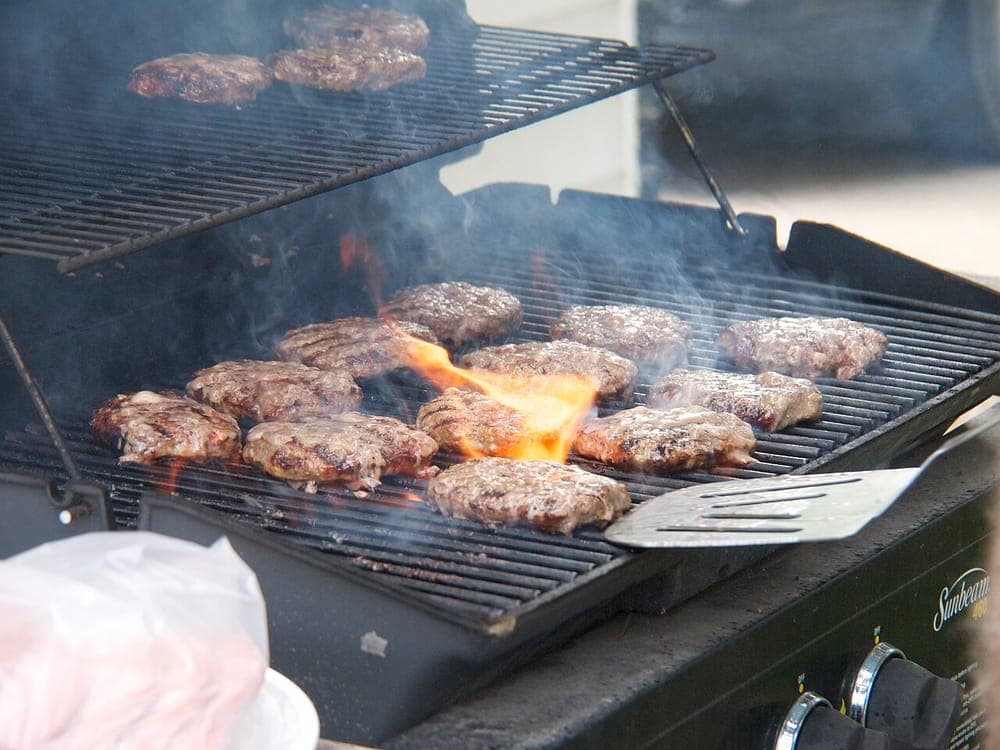 Blackstone 28" Original GriddleMost households Blackstone 28" Original GriddleMost households | Most households | 8.4 | Check price on Amazon |
| 2 | 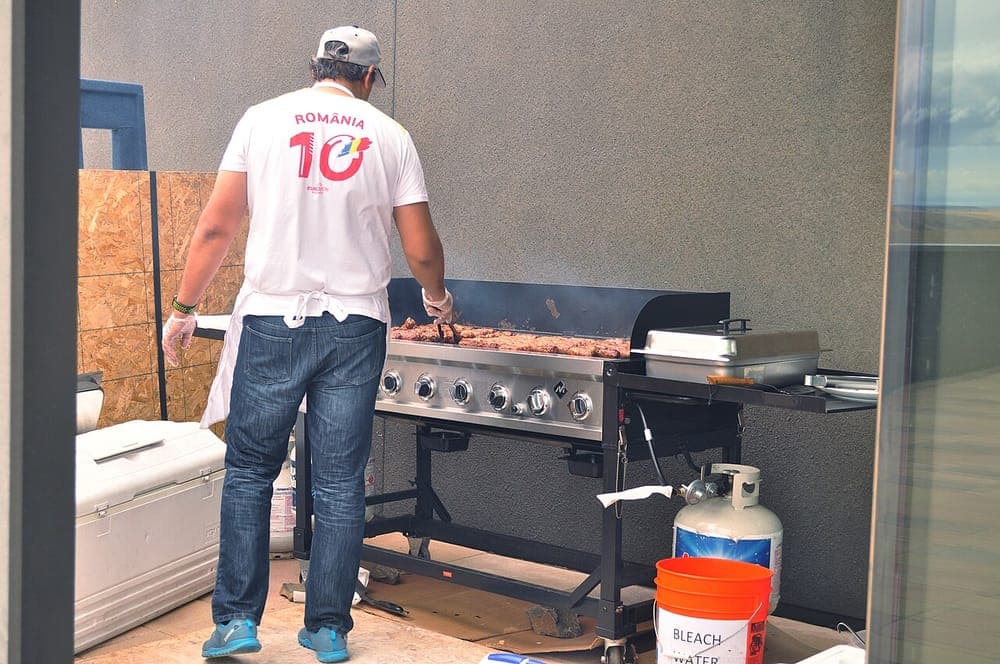 Blackstone 36" Original GriddleLarge families and crowd cooking Blackstone 36" Original GriddleLarge families and crowd cooking | Large families and crowd cooking | 8.6 | Check price on Amazon |
| 3 |  Blackstone 22" Tabletop GriddleTwo zones you can carry Blackstone 22" Tabletop GriddleTwo zones you can carry | Two zones you can carry | 7.8 | Check price on Amazon |
#ad We publish no prices: there is no verified price feed on this site, so the retailer’s page is the only price. How this is funded
If you are genuinely choosing between the Blackstone 22 and the 36, you have not chosen what kind of griddle you want yet — and the answer for most people is neither, it is the 28. The 22 is a 339-square-inch tabletop you carry. The 36 is a 769-square-inch four-burner cart that lives on a patio. That is 2.3 times the surface, 39,000 more BTU, and two different appliances wearing the same brand.
Side by side
Same fields on both sides. Heat density is computed from the published BTU and cooking area, not quoted from a manufacturer.
| Specification | Blackstone 22" Tabletop Griddle | Blackstone 36" Original Griddle |
|---|---|---|
| Cooking area | 339 sq in | 769 sq in |
| Burners | 2 | 4 |
| Total output | 21,000 BTU | 60,000 BTU |
| Heat density | 61.9 BTU / sq in | 78 BTU / sq in |
| Cooktop | Carbon steel | Carbon steel |
| Best for | Two zones you can carry | Large families and crowd cooking |
| Our score | 7.8 / 10 | 8.6 / 10 |
Blackstone 22" Tabletop Griddle: Listed at 21,000 BTU on some retailers and 24,000 BTU on others, both at 339 sq in.
What 430 square inches actually means
Surface area is the specification people most often get wrong, because the numbers are abstract until you convert them into food.
| Griddle | Surface | Realistic one-pass load |
|---|---|---|
| Blackstone 22″ | 339 sq in | Four patties plus onions, or breakfast for two to three |
| Blackstone 28″ | 525 sq in | Eight patties with working room, or breakfast for four |
| Blackstone 36″ | 769 sq in | Eighteen to twenty patties, or breakfast for eight |
Working at roughly 100 to 130 square inches per person for a main meal in one pass — the sizing arithmetic is here — the 22 serves two to three people and the 36 serves six to eight. There is no overlap. One of these is wrong for you by a wide margin.
Heat density: 61.9 against 78.0
The 36 is not merely bigger, it is better heated per square inch of plate. 60,000 BTU across 769 square inches is 78.0 BTU per square inch; the 22’s 21,000 BTU across 339 is 61.9.
That 26% gap shows up as recovery. Put four cold patties on the 22 — which is most of its surface — and the plate temperature falls further and climbs back more slowly than the 36 does with a full load. It is the main reason smash burgers are harder on a tabletop griddle than their surface area alone suggests.
One caution on the 22’s figure: retailers list it at both 21,000 and 24,000 BTU over the same 339 square inches. At 24,000 the density is 70.8 rather than 61.9, which is a materially different griddle. Read the BTU off the exact listing in front of you.
Zones, and what two of them cannot do
Both have independently controlled burners — two on the 22, four on the 36. Burner count is not about power, it is about how many temperatures you can run at once.
With two zones you can sear on one side and hold on the other, which covers most cooking. With four you can sear, cook at moderate heat, hold, and keep a toasting zone, which is what a breakfast for eight actually requires. If you are cooking in waves for a crowd, zones matter more than surface, because the constraint becomes staging rather than space.
Everything else scales with the plate
The specification gap is the obvious part. The running costs scale with it too, and they are easy to forget while comparing cooking areas.
- Fuel. At full output the 36 gets through about 0.66 gallons of propane an hour against the 22’s 0.23 — roughly an hour and a half per gallon against four and a half. The arithmetic, per model. The 22 also runs on 1 lb bottles if you want it to, which the 36 does not.
- Covers. Both need one, and a 36-inch cart cover is a larger, costlier item than a tabletop cover or a carry bag.
- Preheat. 769 square inches of steel takes meaningfully longer to come up to temperature than 339 — how long, and how to shorten it.
- Storage. The 22 goes in a cupboard or a truck. The 36 does not go anywhere, which is the cost that actually bites.
The reason this is the wrong comparison
Portability and footprint, not cooking, are what separate these two. The 22 is a tabletop griddle you can put in a car; the 36 is a four-foot cart that does not go away between cooks. Nobody weighs a tailgate griddle against a patio installation unless the real question is still open.
That open question usually resolves to the Blackstone 28 Original: 525 square inches and two zones on a 10-gauge rolled carbon-steel plate — thicker than most griddles in its class, which is what keeps the temperature steady when cold food lands. It feeds four with headroom, fits a normal patio, and takes a standard cover. It is the size most people should actually buy, and the reason it is the first pick on this page.
Which to buy
| If you | Buy |
|---|---|
| Cook for a family of three to five | Blackstone 28 |
| Cook for six or more, regularly | Blackstone 36 |
| Camp, tailgate or have no patio | Blackstone 22 |
| Need four temperatures at once | Blackstone 36 |
| Have to store the griddle indoors between cooks | Blackstone 22 |
| Want the best plate thickness per dollar | Blackstone 28 |
The adjacent steps are the useful comparisons: 22 vs 28 and 28 vs 36. If the whole Blackstone line is still a blur, we have worked through all five.
The picks in detail
Specifications are linked to their source on every card. Scores are ours, derived from those specifications.
#1 · Most households
Blackstone 28" Original Griddle
The size most people should actually buy: 525 square inches and two zones covers a family of four with headroom, on a footprint that fits a normal patio.
#ad We publish no prices: there is no verified price feed on this site, so the retailer’s page is the only price. How this is funded
Key specifications
- Cooking area
- 525 sq in (28¾ × 18¼ in)
- Burners
- 2, stainless H-burners
- Total output
- 34,000 BTU
- Cooktop
- 10-gauge rolled carbon steel
- Ignition
- Piezo
- Zones
- 2, independently controlled
Specifications from BBQGuys spec sheet.
Scores
- Cooking area7.5
- Heat output7.0
- Zone control7.0
- Surface care6.5
- Portability5.0
What works
- The 10-gauge plate is thicker than most griddles at this size, which is what keeps temperature steady when cold food hits it
- Two zones is genuinely enough: one hot side for searing, one moderate side for holding
- Fits a standard patio and a standard cover, which the 36 often does not
What to know
- Only two zones — you cannot run a dedicated warming zone and two cooking temperatures at once
- 34,000 BTU over 525 sq in is modest heat density; recovery after a big load is slower than the 36
- Bare carbon steel needs seasoning and a cover, same as every Blackstone
#2 · Large families and crowd cooking
Blackstone 36" Original Griddle
The default large griddle: four burners over 769 square inches, with the highest burner count in its size class and the deepest accessory ecosystem of any brand here.
#ad We publish no prices: there is no verified price feed on this site, so the retailer’s page is the only price. How this is funded
Key specifications
- Cooking area
- 769 sq in (35¾ × 21½ in)
- Burners
- 4, stainless steel
- Total output
- 60,000 BTU
- Cooktop
- Carbon steel
- Ignition
- Single spark
- Grease system
- Rear
Specifications from BBQGuys spec sheet.
Scores
- Cooking area9.5
- Heat output9.0
- Zone control9.5
- Surface care6.5
- Portability3.0
What works
- Four independent zones is the real argument for this size — you can hold a warm zone and still sear
- 769 sq in is enough to cook a full breakfast for eight without staging
- The widest accessory and spare-parts availability of any brand in this guide
What to know
- Bare carbon steel: it will rust if you leave it uncovered and unseasoned
- Needs real patio footprint — this is not a griddle you put away each week
- Rear grease management means the drain is behind the unit, which is awkward against a wall
#3 · Two zones you can carry
Blackstone 22" Tabletop Griddle
The smallest Blackstone that still gives you two independent zones, which is what separates a real griddle from a camping plate.
#ad We publish no prices: there is no verified price feed on this site, so the retailer’s page is the only price. How this is funded
Key specifications
- Cooking area
- 339 sq in
- Burners
- 2, stainless H-burners
- Total output
- 21,000 BTU (some variants listed at 24,000)
- Cooktop
- Carbon steel
- Format
- Tabletop; stand and cabinet options sold
- Zones
- 2, independently controlled
Specifications from ShoppersChoice listing.
Listings disagree: Listed at 21,000 BTU on some retailers and 24,000 BTU on others, both at 339 sq in.
Scores
- Cooking area5.0
- Heat output6.0
- Zone control7.0
- Surface care6.5
- Portability8.0
What works
- Two zones in a tabletop is rare and it is the whole reason to pick this over the 17
- Small enough to store on a shelf, big enough to cook four burgers and the onions at once
- Works on a 20 lb tank with an adapter hose rather than only 1 lb bottles
What to know
- 339 sq in fills up fast once you add anything beyond the protein
- BTU rating differs between listings (21,000 vs 24,000) even though the surface area does not
- Tabletop means you need a table — and a heat-safe one
Common questions
Should I buy the Blackstone 22 or the 36?
How much bigger is the Blackstone 36 than the 22?
Is the Blackstone 22 big enough for a family?
Sources
Every specification on this page came from one of these. If you find one of them has changed, tell us and we will correct it.
Read next
Blackstone 22 vs 28
Tabletop against cart: 186 square inches, side shelves, a tank holder and somewhere to put food down.
Blackstone 28 vs 36
244 square inches and two zones apart. Why the 36 is bought more often than it is needed, and when it genuinely is.
Blackstone 22" Tabletop
339 square inches, two independent zones, tabletop. The smallest Blackstone that still cooks like a real griddle.
Blackstone 36" Original
769 square inches, four burners, 60,000 BTU. The large-griddle default — and an honest look at who actually needs it.
What size griddle do I need?
Square inches per person, what each size class holds in practice, and the picks for each — plus why the 36 is usually a mistake.
Which Blackstone griddle should you buy?
The whole Blackstone line sorted by who it is for: 17, 22, 28, 28 XL and 36, with heat density on each.