The best 3-burner griddles
Three is the first zone count where you can hold food warm without surrendering a cooking temperature — and it costs far less footprint than four.
We earn a commission if you buy through our links, at no extra cost to you. That is how this site is paid for, and it does not decide what we recommend — full disclosure.
Quick picks
Ranked on published specifications using our scoring rubric. Tap a row for the full write-up.
| # | Product | Best for | Score | Price |
|---|---|---|---|---|
| 1 | 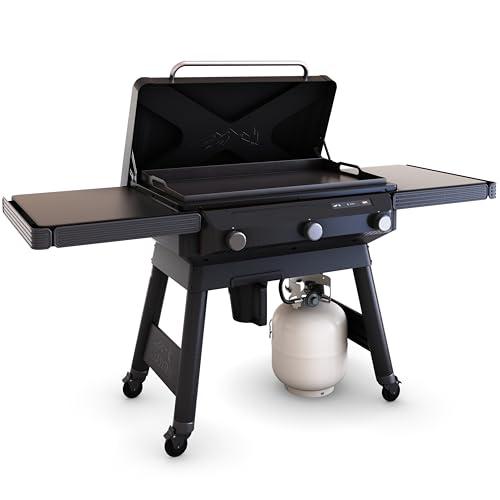 Traeger Flatrock 3-Zone GriddleSearing and zone discipline | Searing and zone discipline | 8.8 | $799.00View on Amazon |
| 2 | 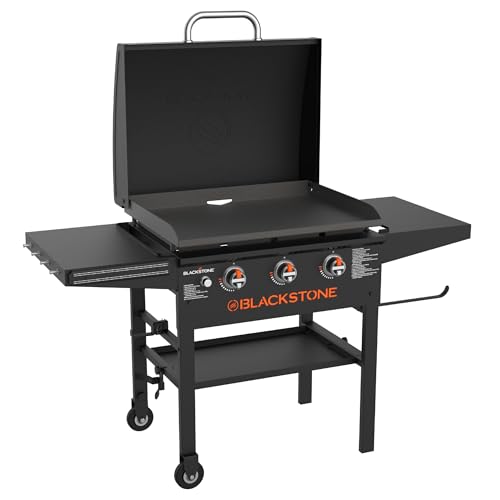 Blackstone 28" XL Omnivore GriddleThree zones without the 36's footprint | Three zones without the 36's footprint | 7.9 | $439.99View on Amazon |
| 3 | 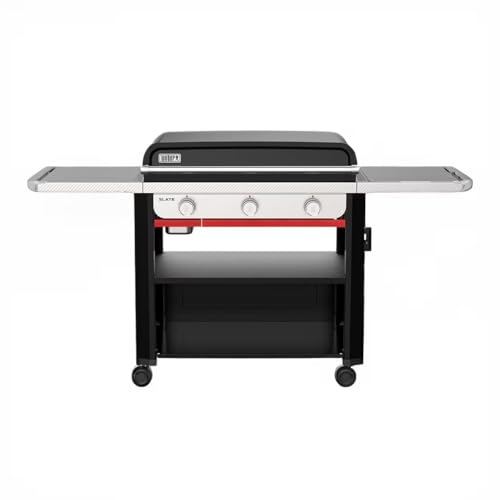 Weber Slate 30" GriddleOccasional cooks who hate rust | Occasional cooks who hate rust | 8.5 | $649.00View on Amazon |
| 4 | 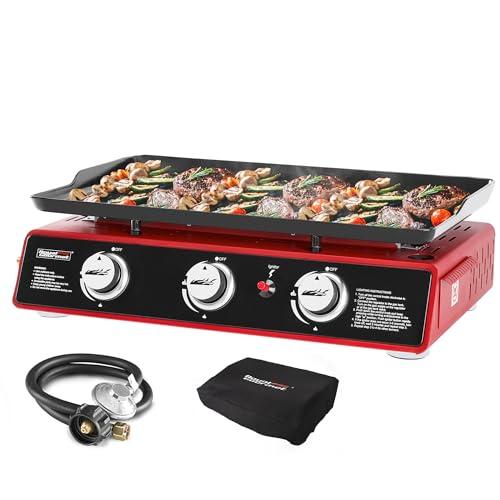 Royal Gourmet PD1301R Portable GriddleThree zones under 30 pounds | Three zones under 30 pounds | 7.6 | $109.69View on Amazon |
#ad Price as of November 28, 2026; prices change — check the retailer. How this is funded
Three burners is the most useful zone count on a griddle, and it is the one the category talks about least. Two-burner griddles get recommended for being affordable and four-burner griddles get recommended for being big. Three sits between them without a marketing story, which is a shame, because it is where the cooking arithmetic works out best for most households.
What the third zone buys that the second cannot
A griddle zone is not a quantity of heat. It is a temperature you can commit to and leave alone. That framing is the whole argument for this class.
With two zones you get one hot and one less hot, and every time you need a third temperature you have to take one away. Put a holding area on a two-burner griddle and you have given up either your sear or your working heat — there is nothing left to give.
With three zones you can run a sear at the top of the range, a working temperature in the middle and a holding zone turned right down, all at once and all the way through a cook. A full breakfast is exactly that: bacon rendering slowly, eggs gently, pancakes steady at around 350 °F, and finished food waiting somewhere it will not keep cooking.
The fourth zone, by contrast, buys a second staging lane. Useful when you are plating for eight in waves, and almost nothing for a family of four. We have worked the two-against-four version of this through in 2-burner vs 4-burner griddles, and how many burners do you need takes it from the household-size end.
The criteria, before the picks
Three-burner griddles range from a 319-square-inch tabletop to a 738-square-inch cart, so “three burners” on its own tells you almost nothing. These are the five things we ranked on, in order of how much they change the cooking.
- Square inches per zone. Divide the cooking area by the burner count and you get the size of one committed temperature. This is the figure that decides whether a zone can hold a real amount of food or only a token amount, and nobody publishes it.
- Heat density — BTU per square inch. Total BTU is a marketing number on a plate you can only load so heavily. Heat per square inch is what determines whether the surface holds its temperature when cold food lands. The arithmetic, in full.
- Zone independence. Burners are controlled separately on every griddle here, but heat still bleeds sideways through the plate. Insulation between zones is the difference between a holding area that holds and one that slowly cooks.
- Cooktop material and what it asks of you. Bare carbon steel gives the most heat and demands seasoning and covering. Rust-resistant and enameled surfaces forgive neglect and give up some heat for it. The materials compared.
- Footprint, honestly measured. A three-burner cart is close to six feet wide once the side shelves are out. That is a patio decision, not a kitchen one.
We have not cooked on these in a test kitchen and we do not claim to have. Every number below comes from a manufacturer or retailer specification, linked at the foot of the page, and the scores on each card are ours, derived from those numbers by the rubric at how we choose.
Square inches per zone: the figure nobody prints
Run the division across this class and the ranking it produces is not the ranking by size.
| Griddle | Cooking area | Per zone |
|---|---|---|
| Blackstone 28″ XL Omnivore | 613 sq in | 204 sq in |
| Traeger Flatrock 3-Zone | 594 sq in | 198 sq in |
| Weber Slate 30″ | 540 sq in | 180 sq in |
| Royal Gourmet PD1301 | 319 sq in | 106 sq in |
Roughly 200 square inches per zone — the top three — is about a 14-inch square. That holds four smash-burger patties with room to work, or a row of pancakes, or bacon for five. It is a zone you can actually commit.
106 square inches is a 10-inch square, which is one pan’s worth. Three zones at that size is real control over a small amount of food, which is a genuine thing to want on a tabletop and not the same proposition as the carts above it.
Heat density across the class
Computed from published output and published area, so it is reproducible rather than asserted:
- Royal Gourmet PD1301 — 79.9 BTU per sq in (25,500 over 319)
- Traeger Flatrock 3-Zone — 79.1 (47,000 over 594)
- Blackstone 28″ XL — 73.4 (45,000 over 613)
- Weber Slate 30″ — 66.7 (36,000 over 540)
Top to bottom that is a 20% spread. Two caveats matter more than the ranking.
First, the Blackstone figure depends on which example you buy. The same 613-square-inch body is listed at 28,500, 45,000 and 48,000 BTU by different retailers — which works out as anything from 46.5 to 78.3 BTU per square inch. The surface area is settled; the heat output is not. Read the BTU rating off the listing in front of you rather than off a review, this one included.
Second, high density on a small plate is not the same as high density on a large one. The Royal Gourmet tops the table because 319 square inches is an easy plate to keep hot, not because it out-cooks a Traeger.
The picks, and what each one gives up
Traeger Flatrock 3-Zone — the one we would buy. 594 square inches, 79.1 BTU per square inch, and zones that are physically insulated from each other rather than merely controlled separately. That last part is the reason it leads: on an uninsulated plate a “warm” zone drifts upward because the burner next door is heating the steel between them. The cost is a carbon-steel top that needs seasoning and covering, a stated range that starts at 350 °F and so is less controllable at the gentle end, and the smallest accessory ecosystem of the four major brands. It is also the most expensive griddle here by a clear margin.
Blackstone 28″ XL Omnivore — the best zone-to-footprint ratio Blackstone sells. 613 square inches is the largest plate in this guide outside the 36-inch class, and three zones over it gives the biggest individual zones of any pick here. Electronic ignition is more reliable over time than a piezo button, and Blackstone’s parts and accessory support has no equal. What you give up: the BTU inconsistency above, which is a real buying risk rather than a footnote, and an Omnivore plate that takes seasoning differently from the classic carbon-steel tops people write their routines for.
Weber Slate 30″ — for anyone who would rather not fight a surface. Three zones over 540 square inches on a rust-resistant, pre-seasoned top, with four swivel casters so it genuinely moves on a patio. It is the pick for someone who cooks once a fortnight and wants the griddle to still be fine in March. The price is heat: 66.7 BTU per square inch is the lowest here, the coating is resistant rather than invincible and still wants a cover, and at 140 lb it moves on flat ground and nowhere else.
Royal Gourmet PD1301 — three zones you can carry. 29.3 lb, 319 square inches, three separately controlled burners and a porcelain-enameled top that needs no seasoning routine in a garage. Three-zone control in a tabletop is genuinely unusual. The trades are real: 106 square inches per zone fills up past three people, enamel chips and a chipped enamel top rusts outward from the chip, and the build is lighter than the Blackstone or Weber tabletops. The portable class in full if that is the direction you are heading.
The pick we left out, and why
LoCo’s 36″ SmartTemp 3-Burner is on paper the most interesting griddle in this class — 738 square inches, 246 per zone, and a digital thermostat that holds a set temperature in 25-degree increments instead of a knob position. No other griddle here does that.
It is not a pick because we could not establish that it is reliably purchasable. When we checked for this guide, BBQGuys listed it sold out, Bass Pro listed it as not available online, and the Home Depot listings showed no store stock. We will not send you to a buy button for something we cannot confirm you can buy. Our LoCo spec page and Blackstone vs LoCo stay up because the specifications are still worth knowing if you find one.
Three burners against two, and against four
Against two: you are buying a third committed temperature, and roughly 60 to 90 more square inches of plate for it. If your cooking is one protein at a time, two zones and a decent cover is the better use of the money. If a single meal regularly involves three things at three temperatures, the step up pays for itself the first weekend. The 2-burner class.
Against four: you are giving up a second staging lane and, usually, 100 to 200 square inches. You are also giving up about a foot of patio and a chunk of money. Four burners only earn their keep when the zones get used differently — run flat out, a four-burner griddle is a large single-zone griddle with a higher gas bill. The 4-burner class.
One thing worth noting across the sizes: a three-zone 540-square-inch Weber Slate 30 gives more control than a two-zone 525-square-inch Blackstone 28 at essentially the same footprint. Zone count and size are separate axes, and the size pages tend to blur them. The 28 to 30-inch class covers that overlap directly.
Before you buy a three-burner cart
- Measure the width with the shelves out. These are close to six feet wide in use. Measure where it will live, not where it will be unboxed.
- Decide the surface question first. Bare steel or coated is a bigger difference in ownership than any spec on this page. Which griddles are easiest to clean is the honest version of that decision.
- Budget for a cover on day one. On a carbon-steel top it is not an accessory, it is part of the griddle.
- Expect to map your zones. Even separately controlled burners produce hot and cool patches, and knowing yours is worth more than a spec upgrade. Finding your hot spots.
What we cannot tell you
We have not run these side by side, so we make no claim about how evenly any particular plate holds temperature across its surface, how well a coating survives two seasons, or how one brand’s warranty service behaves. Where retailers disagree about a specification — and on the Blackstone 28″ XL they badly do — we publish the disagreement instead of quietly picking the flattering number.
What we can tell you is the part that does not change: the size of a zone, the heat behind it, and what each surface will ask of you for as long as you own it.
The picks in detail
Specifications are linked to their source on every card. Scores are ours, derived from those specifications.
#1 · Searing and zone discipline
Traeger Flatrock 3-Zone Griddle
594 square inches with three insulated zones and 79.1 BTU per square inch — the highest usable heat density of any mid-size griddle here.
#ad Price as of November 28, 2026; prices change — check the retailer. How this is funded
Key specifications
- Cooking area
- 594 sq in
- Burners
- 3 (TruZone, insulated)
- Total output
- 47,000 BTU
- Cooktop
- Carbon steel
- Stated range
- 350–600 °F
- Dimensions
- 74 W × 42 H × 27 D in
Specifications from Abt spec sheet.
Scores
- Cooking area8.0
- Heat output9.5
- Zone control9.5
- Surface care6.5
- Portability3.5
What works
- Insulated zones are the real feature — heat does not bleed sideways, so a 'warm' zone stays warm
- 79.1 BTU per sq in is the best heat density in its size class, which is what you feel when six patties hit the plate
- Three genuinely independent zones in a body smaller than a 36
What to know
- Carbon steel, so you are back to seasoning and covering it
- The stated 350–600 °F range is narrower at the bottom than rivals — gentle holding is less controllable
- Smallest accessory ecosystem of the four major brands
#2 · Three zones without the 36's footprint
Blackstone 28" XL Omnivore Griddle
Three zones in a 613-square-inch body — the useful middle ground — but the BTU rating genuinely varies between variants, so read it off the listing in front of you.
#ad Price as of November 28, 2026; prices change — check the retailer. How this is funded
Key specifications
- Cooking area
- 613 sq in
- Burners
- 3
- Total output
- 28,500 / 45,000 / 48,000 BTU depending on variant
- Cooktop
- Omnivore plate
- Ignition
- Electronic
- Height
- 59.44 in
Specifications from Academy Sports listing.
Listings disagree: Retailers list this body at 28,500 BTU (Academy), 45,000 BTU and 48,000 BTU — all at 613 sq in. The surface area is settled; the heat output is not. Check the BTU figure on the exact listing you are buying.
Scores
- Cooking area8.0
- Heat output7.5
- Zone control8.5
- Surface care6.5
- Portability4.0
What works
- Three zones at 613 sq in is the best zone-to-footprint ratio Blackstone sells
- Electronic ignition is more reliable over time than a piezo button
- Meaningfully more surface than the 28 without the 36's storage problem
What to know
- The BTU rating is not consistent across listings — the same 613 sq in body appears at 28,500, 45,000 and 48,000 BTU
- A 28,500 BTU example over 613 sq in is thin heat; that variant recovers slowly
- The Omnivore plate is a different surface from the classic carbon steel and takes seasoning differently
#3 · Occasional cooks who hate rust
Weber Slate 30" Griddle
Three zones over 540 square inches on a rust-resistant top — the best griddle here for someone who cooks once a fortnight and does not want to fight their surface.
#ad Price as of November 28, 2026; prices change — check the retailer. How this is funded
Key specifications
- Cooking area
- 540 sq in
- Burners
- 3, stainless steel
- Total output
- 36,000 BTU
- Cooktop
- Rust-resistant carbon steel, pre-seasoned
- Dimensions
- 70.80 W × 39.50 H × 23.50 D in
- Weight
- 140.34 lb
Specifications from P.C. Richard spec sheet.
Scores
- Cooking area7.5
- Heat output7.0
- Zone control8.5
- Surface care9.5
- Portability4.0
What works
- Three zones at 540 sq in beats the Blackstone 28's two zones at 525 sq in — more control for the same footprint
- Rust resistance is the difference between a griddle that survives a wet autumn and one that does not
- Four swivel casters, so it actually moves on a patio
What to know
- 140 lb means 'moves on a patio', not 'goes in the truck'
- 66.7 BTU per sq in is middling — fine for everyday cooking, slower than the Traeger for a heavy sear
- The rust-resistant coating is not invincible; it still wants a cover
#4 · Three zones under 30 pounds
Royal Gourmet PD1301R Portable Griddle
Three separately controlled burners over 319 square inches at 29.3 lb — more zone control than any other truly portable griddle here.
#ad Price as of November 28, 2026; prices change — check the retailer. How this is funded
Key specifications
- Cooking area
- 319 sq in (23.82 × 13.39 in)
- Burners
- 3, separately controlled
- Total output
- 25,500 BTU
- Cooktop
- 3.5 mm porcelain-enameled steel
- Weight
- 29.3 lb
- Dimensions
- 26.69 × 16.14 × 7.87 in
Specifications from Home Depot listing.
Scores
- Cooking area4.5
- Heat output7.5
- Zone control8.0
- Surface care7.5
- Portability8.5
What works
- Three zones in a 29 lb tabletop is genuinely unusual
- 79.9 BTU per square inch — the highest density of any portable here
- Porcelain enamel means no seasoning routine on a griddle that lives in a garage
What to know
- Porcelain enamel chips, and a chipped enamel top rusts from the chip outward
- 319 sq in is small once you are cooking for more than three
- Lighter build than the Blackstone or Weber tabletops
Common questions
Is a 3-burner griddle enough?
Which 3-burner griddle has the best heat density?
How big is one zone on a 3-burner griddle?
Is a 3-burner griddle better than a 4-burner?
Why is the LoCo 36" SmartTemp not one of the picks?
Sources
Every specification on this page came from one of these. If you find one of them has changed, tell us and we will correct it.
Read next
The best 2-burner griddles
Two-burner griddles compared. Where two zones is genuinely enough, and the one spec that separates these five.
The best 4-burner griddles
Four-burner griddles compared. What the fourth zone actually buys, and the 29% heat-density spread hiding inside this class.
How many burners do you need?
What one, two, three and four zones actually buy you, why insulation matters, and the picks at each burner count.
The best 28-inch griddles
The 28 to 30-inch class compared. Two zones or three, bare steel or rust-resistant, and why this is the right size for most people.
Weber Slate 30 vs 36
Weber's 30 against its 36: a fourth zone and 216 more square inches, against higher heat density and a shallower footprint.
Griddle BTU, explained
Why total BTU is close to meaningless, how heat density reorders the category, and which griddles actually recover under load.