Weber Slate griddle alternatives
The Slate line solves one ownership problem better than anything else here. This is what to buy when that problem is not yours.
We earn a commission if you buy through our links, at no extra cost to you. That is how this site is paid for, and it does not decide what we recommend — full disclosure.
Quick picks
Ranked on published specifications using our scoring rubric. Tap a row for the full write-up.
| # | Product | Best for | Score | Price |
|---|---|---|---|---|
| 1 | 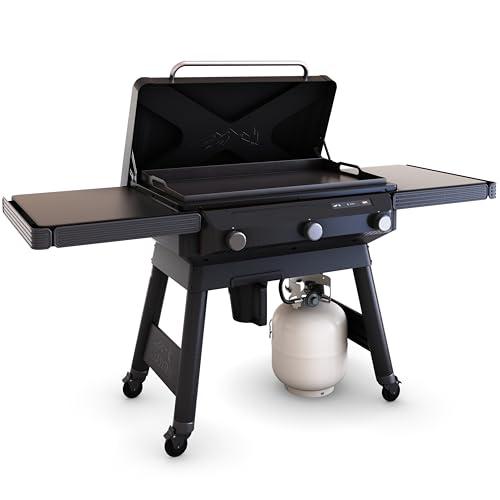 Traeger Flatrock 3-Zone GriddleSearing and zone discipline | Searing and zone discipline | 8.8 | $799.00View on Amazon |
| 2 | 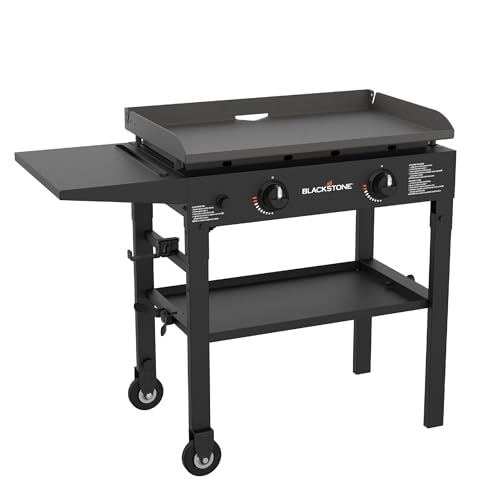 Blackstone 28" Original GriddleMost households | Most households | 8.4 | $199.99View on Amazon |
| 3 | 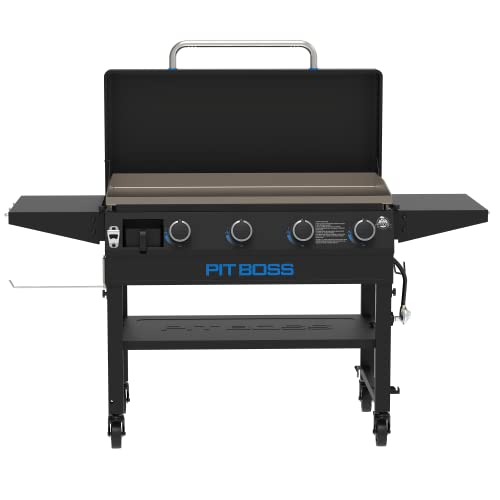 Pit Boss Deluxe 4-Burner GriddleRaw heat per square inch | Raw heat per square inch | 8.5 | $570.81View on Amazon |
| 4 | 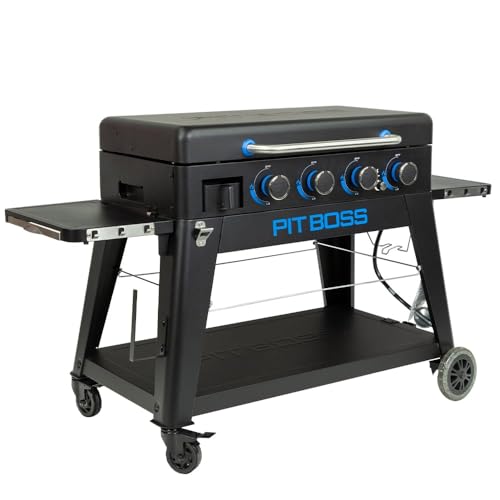 Pit Boss Ultimate Lift-Off 4-Burner GriddleSkipping the seasoning routine entirely | Skipping the seasoning routine entirely | 8.1 | $734.65View on Amazon |
| 5 | 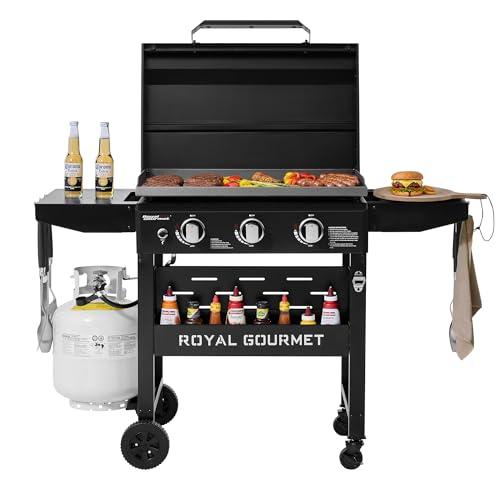 Royal Gourmet GB3000PB 3-Burner GriddleThree zones at a two-burner price | Three zones at a two-burner price | 8.0 | $227.39View on Amazon |
| 6 | 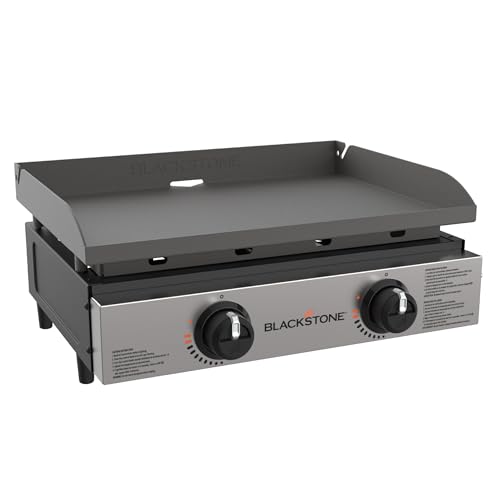 Blackstone 22" Tabletop GriddleTwo zones you can carry | Two zones you can carry | 7.8 | $152.14View on Amazon |
#ad Price as of November 28, 2026; prices change — check the retailer. How this is funded
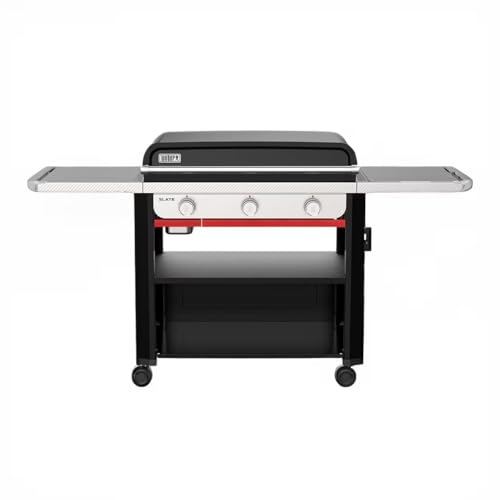
Start with what the Slate line is known for, because it is a genuine achievement and the reason this page exists at all. Weber’s Slate griddles ship with a rust-resistant carbon-steel cooktop that arrives pre-seasoned, which changes the ownership experience rather than the cooking one: the plate tolerates a damp autumn, a missed oiling and a cover you forgot to put back on, and your first cook is genuinely a cook rather than a seasoning session. Weber also includes things other brands sell separately — a lid, extendable side tables, four swivel casters, a digital thermometer on some configurations — and it does all of it behind the biggest dealer and warranty network in outdoor cooking. On the 30, you get three independently controlled zones over 540 square inches, which is more control than the bare-steel cart most people cross-shop it against.
None of that is in dispute. “Alternative to a Weber Slate” is not a complaint about the Slate — it is a specific requirement the Slate does not happen to meet. There are five of them, and each one points at a different griddle.
The five reasons people shop away from a Slate
Work out which of these is yours before you read the picks, because solving one of them usually makes another one worse. That is why “the best Slate alternative” has no single answer.
- Heat per square inch. This is the Slate line’s weakest specification and the most common reason to look elsewhere. The Slate 36 runs 63.5 BTU per square inch, the Slate 30 runs 66.7 and the Slate 22 runs 45.5 — against roughly 78 to 82 for bare-steel carts at comparable sizes. Heat density, explained is the arithmetic. You feel the gap at one specific moment: a full load of cold food goes down and the plate temperature falls further and recovers more slowly.
- Price. A Slate costs more than the equivalent bare-steel griddle and delivers less heat for the money. If you are buying on specification per dollar, the Slate is never the winner.
- Accessories and spare parts. Weber’s network is excellent for Weber-branded accessories, but the third-party ecosystem — covers, caddies, hard covers, griddle-specific tools, replacement tops — is built around Blackstone sizes first. If you like buying accessories, you are shopping in the wrong brand.
- You want no maintenance at all, not less of it. Rust-resistant steel is still steel: it still wants seasoning, oiling and a cover, just with far more forgiveness built in. A coated plate removes the routine entirely.
- Weight and portability. A Slate 30 is 140 lb. It moves on a patio and it does not go in a truck, and the Slate 22 is the heaviest, widest tabletop in its class.
We have not cooked on these in a test lab and do not claim to have. Every figure below is published by a manufacturer or a major retailer and linked at the foot of the page, and every pick was checked as currently purchasable when this page was written.
1. Traeger Flatrock 3-Zone — the alternative that out-heats it
If reason one is yours, this is the answer, and it is the closest thing to a direct swap for a Slate 30. 47,000 BTU across 594 square inches is 79.1 BTU per square inch — nineteen percent more heat per square inch than the Slate 30 — and the Flatrock does something no Weber does: it insulates each zone from its neighbors.
That second point matters more than the headline figure. On most griddles heat bleeds sideways, so a “warm” zone beside a searing zone does not stay warm and you end up chasing temperature around the plate. Three insulated TruZone sections hold their own temperatures, which is what makes a hold-and-sear routine work on a surface this size.
The honest cons. You have given up the entire reason people buy a Slate: the Flatrock is bare carbon steel, so seasoning, oiling and a correctly sized vented cover are all back on your list. Its stated range starts at 350 °F, higher at the bottom end than rivals, so genuinely gentle holding is less controllable than the spec sheet implies. And Traeger has the smallest accessory range of the four major brands — a cover and a cleaning kit, not an ecosystem. Weber Slate vs Traeger Flatrock is the full head-to-head.
2. Blackstone 28 — the alternative with everything made for it
Reason three, and the most popular cross-shop in the category. 525 square inches and two independently controlled zones is a hair under the Slate 30 on area and a zone behind it on control — but the plate is 10-gauge rolled carbon steel, roughly 3.4 mm, and the 28-inch Blackstone footprint is the single best-supported size in outdoor cooking. Covers, hard covers, caddies, carry bags, replacement tops, burners, regulators and igniters are all stocked by name, by multiple makers, at the major home centers.
The honest cons. Two zones means you cannot run a dedicated warming zone and two cooking temperatures at once, which the three-zone Slate 30 can. 34,000 BTU over 525 square inches is modest heat density, so this is not the pick for reason one. And it is bare carbon steel, so it has the rust clock the Slate was bought to escape: uncovered and unoiled, it will bloom in a couple of damp weeks. Blackstone vs Weber Slate works the trade properly, and which Blackstone griddle to buy picks between the sizes.
3. Pit Boss Deluxe 4-Burner — the alternative with the thickest plate
Reasons one and two together, at 36-inch size. 62,000 BTU across 753 square inches is 82.3 BTU per square inch, the highest heat density of any griddle on this site and nearly thirty percent above the Slate 36 — and it sits on a 4.7 mm plate, thicker than anything Weber or Blackstone uses at this size. Plate thickness is what stops the surface diving when cold food lands, so the thickness and the density compound rather than trade off. Why plate thickness matters is the detail.
The honest cons. Fold-and-go legs are less stable than a fixed cart under a loaded 753-square-inch top, and this is a lot of griddle to have on folding legs. The sibling SKU is listed at 748 square inches with a slightly different top, so check which one you are buying. It is a bare steel plate, pre-seasoned from the factory — which is not the same thing as rust-resistant, and wears off in normal use. And Pit Boss’s accessory support sits between Blackstone’s and Traeger’s. Pit Boss vs Weber Slate is the pairing in full.
4. Pit Boss Ultimate Lift-Off — the alternative with no routine at all
Reason four. If you looked at a Slate because you were tired of maintaining a griddle, the Ultimate goes one step further than rust-resistant steel: its plate is non-stick armored ceramic, so there is no first-time seasoning, no polymerizing, no oil film after every cook and no rust clock on the cooking face at all. Four zones across 647 square inches at 46,000 BTU, a removable grease tray, and a top that lifts off so the plate can be carried to a sink rather than cleaned in place.
The honest cons. A coating is a wear item, and that is the real trade against a Slate: treated steel can be scraped, stoned and re-seasoned indefinitely, while a worn or chipped ceramic top cannot be re-coated. It also rules out metal spatulas and scrapers, which is most of the griddle toolkit. The lift-off top weighs 89 lb, so “removable for cleaning” is realistically a two-person job. And a non-stick surface does not build the fond that makes a seasoned steel plate sear the way it does. The rust-resistant ranking puts this surface against the Slate’s directly.
5. Royal Gourmet GB3000PY — the budget pick
This is the budget pick on this page, and it is the clearest answer to reason two. 492 square inches with three independently controlled burners and 39,000 BTU is 79.3 BTU per square inch — roughly nine percent less plate than a Slate 30, the same three-zone control, and nineteen percent more heat per square inch, with a hood, electronic ignition, lockable wheels and folding shelves included rather than extra.
The honest cons. The 3 mm top is thinner than the plate Blackstone and Pit Boss use at this size, so it dips further under a load of cold food. Accessory and parts support is a fraction of either big brand’s — covers, hard covers and replacement tops are model-specific and harder to source, which is the real cost of buying outside the big names. It is bare sandblasted, oil-baked steel, so the seasoning routine is back with much less documentation behind it. And the listings disagree about the BTU figure: Overton’s spec table reads 39,000 BTU per burner while Royal Gourmet’s own title and Lowe’s give 39,000 as the three-burner total, which is the figure we use. The budget roundup ranks this layer of the market properly.
6. Blackstone 22″ Tabletop — the alternative you can actually carry
Reason five. If the Slate you were considering was the 22-inch tabletop, the honest comparison is not about the surface at all — it is that the Slate 22 is 37 inches wide with the lid closed and needs a substantial table, while the Blackstone 22 stores on a shelf and travels. 339 square inches across two independently controlled zones, on a 20 lb tank with an adapter hose rather than only 1 lb bottles.
The honest cons. 339 square inches fills up fast once you add anything beyond the protein, and it is 13 square inches short of the Slate 22. The BTU rating differs between listings — 21,000 on some retailers and 24,000 on others at the same surface area — so read it off the listing in front of you. It is bare carbon steel on the griddle format least likely to get a maintenance routine, which is exactly where the Slate 22’s treated top earns its keep. Blackstone 22 vs Weber Slate 22 is the direct pairing, and the tabletop roundup ranks the class on what you stand it on.
Two Slate rivals we are not putting a buy button on
Both come up constantly in the same searches, and each fails a check we apply before linking anything.
Camp Chef Flat Top Grill 600. For years the most interesting Slate alternative in the category, because it genuinely converts between a 604-square-inch griddle and a 501-square-inch grill with real grates rather than a ridged plate. Camp Chef’s own site describes the model as discontinued and we could not find it in stock at a mainstream retailer, so it is discussed rather than picked. Camp Chef vs Weber Slate stays up as a reference.
Nexgrill Daytona. The home-center answer at 36-inch size, and the one with a genuine specification problem: retailers list 756 square inches and 60,000 BTU, while Nexgrill’s own current product page gives 792 square inches and 38,000 BTU for the same name. That is not a rounding difference, and stock at the big retailers has been patchy. Our Nexgrill review explains what to read off the box.
What switching away from a Slate costs you
Four things, and they are the reasons the Slate line exists. Count them before you treat a cheaper or hotter griddle as an upgrade.
- The rust clock comes back. Five of the six picks above are bare steel. If you cook every other week and store the griddle outdoors, that is the trade you are making, and the prevention routine becomes your job again.
- Included becomes extra. A lid, side tables and casters are standard on a Slate cart and optional on several alternatives. Price the griddle you are actually going to own.
- Warranty reach. Weber’s service and dealer network is the deepest in outdoor cooking. Royal Gourmet’s is not, and that gap is invisible until something fails.
- Pre-seasoned means something different. Several alternatives advertise a pre-seasoned plate. That is a factory oil layer that wears off, not a treatment of the steel, and it is not what the Slate is selling.
Which alternative to buy
| If your reason is | Buy |
|---|---|
| More heat, and zones that stay separate | Traeger Flatrock 3-Zone |
| Accessories, spares and a cover that fits | Blackstone 28 |
| The thickest plate and the most heat at 36 inches | Pit Boss Deluxe 4-Burner |
| No seasoning routine at all | Pit Boss Ultimate Lift-Off |
| Three zones for the least money | Royal Gourmet GB3000PY |
| Something you can lift and store | Blackstone 22″ Tabletop |
| A grill and a griddle in one unit | Nothing we can currently link — see Camp Chef above |
And if, having read the five reasons, none of them is actually yours — you cook occasionally, you store the griddle outside and you would rather not fight the surface — buy the Slate. That is a legitimate outcome of this page. Our Slate 30 review is the model most people land on, the rust-resistant ranking explains exactly what its surface buys you, and the brand ranking compares Weber against the rest on parts, ecosystem and spec-sheet honesty rather than on one model.
The picks in detail
Specifications are linked to their source on every card. Scores are ours, derived from those specifications.
#1 · Searing and zone discipline
Traeger Flatrock 3-Zone Griddle
594 square inches with three insulated zones and 79.1 BTU per square inch — the highest usable heat density of any mid-size griddle here.
#ad Price as of November 28, 2026; prices change — check the retailer. How this is funded
Key specifications
- Cooking area
- 594 sq in
- Burners
- 3 (TruZone, insulated)
- Total output
- 47,000 BTU
- Cooktop
- Carbon steel
- Stated range
- 350–600 °F
- Dimensions
- 74 W × 42 H × 27 D in
Specifications from Abt spec sheet.
Scores
- Cooking area8.0
- Heat output9.5
- Zone control9.5
- Surface care6.5
- Portability3.5
What works
- Insulated zones are the real feature — heat does not bleed sideways, so a 'warm' zone stays warm
- 79.1 BTU per sq in is the best heat density in its size class, which is what you feel when six patties hit the plate
- Three genuinely independent zones in a body smaller than a 36
What to know
- Carbon steel, so you are back to seasoning and covering it
- The stated 350–600 °F range is narrower at the bottom than rivals — gentle holding is less controllable
- Smallest accessory ecosystem of the four major brands
#2 · Most households
Blackstone 28" Original Griddle
The size most people should actually buy: 525 square inches and two zones covers a family of four with headroom, on a footprint that fits a normal patio.
#ad Price as of November 28, 2026; prices change — check the retailer. How this is funded
Key specifications
- Cooking area
- 525 sq in (28¾ × 18¼ in)
- Burners
- 2, stainless H-burners
- Total output
- 34,000 BTU
- Cooktop
- 10-gauge rolled carbon steel
- Ignition
- Piezo
- Zones
- 2, independently controlled
Specifications from BBQGuys spec sheet.
Scores
- Cooking area7.5
- Heat output7.0
- Zone control7.0
- Surface care6.5
- Portability5.0
What works
- The 10-gauge plate is thicker than most griddles at this size, which is what keeps temperature steady when cold food hits it
- Two zones is genuinely enough: one hot side for searing, one moderate side for holding
- Fits a standard patio and a standard cover, which the 36 often does not
What to know
- Only two zones — you cannot run a dedicated warming zone and two cooking temperatures at once
- 34,000 BTU over 525 sq in is modest heat density; recovery after a big load is slower than the 36
- Bare carbon steel needs seasoning and a cover, same as every Blackstone
#3 · Raw heat per square inch
Pit Boss Deluxe 4-Burner Griddle
62,000 BTU across 753 square inches — 82.3 BTU per square inch, the highest heat density of any griddle in this guide.
#ad Price as of November 28, 2026; prices change — check the retailer. How this is funded
Key specifications
- Cooking area
- 753 sq in (top 37 × 20 in)
- Burners
- 4, separately controlled stainless
- Total output
- 62,000 BTU
- Cooktop
- 4.7 mm steel, pre-seasoned with organic oil
- Portability
- Fold-and-go
- Includes
- Side shelves and lid
Specifications from Pit Boss product page.
Listings disagree: Sold as 753 sq in (model 10963) and 748 sq in (model 10942), both at 62,000 BTU.
Scores
- Cooking area9.5
- Heat output10.0
- Zone control9.5
- Surface care7.0
- Portability4.5
What works
- 82.3 BTU per square inch is the highest here — it recovers fastest when a full load of cold food goes down
- A 4.7 mm plate is thick for this price class, which is what buys you stable temperature
- Pre-seasoned with organic oil, so it is usable sooner than a bare plate
What to know
- Fold-and-go legs are less stable than a fixed cart under a loaded 753 sq in top
- The sibling SKU is listed at 748 sq in with a slightly different top — check which you are buying
- Still a steel top: seasoning and covering are on you
#4 · Skipping the seasoning routine entirely
Pit Boss Ultimate Lift-Off 4-Burner Griddle
The only griddle here with a non-stick armored ceramic surface rather than steel — no seasoning, no rust, and a different set of trade-offs.
#ad Price as of November 28, 2026; prices change — check the retailer. How this is funded
Key specifications
- Cooking area
- 647 sq in
- Burners
- 4, stainless steel
- Total output
- 46,000 BTU
- Cooktop
- Non-stick armored ceramic
- Lift-off top
- 89 lb
- Grease
- Removable tray
Specifications from Pit Boss product page.
Scores
- Cooking area8.5
- Heat output8.0
- Zone control9.5
- Surface care8.0
- Portability3.0
What works
- No seasoning and no rust — this is a genuinely different ownership experience from every steel top here
- Four zones across 647 sq in, and the top lifts off for cleaning
- Folding shelves with built-in tool hooks
What to know
- A ceramic coating is a wear item — steel can be restored indefinitely, a coating cannot
- The lift-off top weighs 89 lb; 'removable for cleaning' is a two-person job
- Non-stick surfaces do not develop the fond that makes a seasoned steel top sear the way it does
#5 · Three zones at a two-burner price
Royal Gourmet GB3000PB 3-Burner Griddle
492 square inches and three independently controlled burners with a hood, lockable wheels and shelves included — the same plate area as a Blackstone 28 with an extra zone on it.
#ad Price as of November 28, 2026; prices change — check the retailer. How this is funded
Key specifications
- Cooking area
- 492 sq in (27.76 × 17.72 in)
- Burners
- 3, stainless steel
- Total output
- 39,000 BTU
- Cooktop
- 3 mm sandblasted, oil-baked steel
- Weight
- 76.1 lb net
- Dimensions
- 52.44 × 23.17 × 37.22 in, shelves out
Specifications from Overton's listing (GB3000PY).
Listings disagree: Overton's spec table reads 39,000 BTU per burner. Royal Gourmet's own product title and Lowe's both state 39,000 BTU as the total for three burners, which is the figure used here.
Scores
- Cooking area7.0
- Heat output8.5
- Zone control8.0
- Surface care6.0
- Portability4.0
What works
- Three independent zones on a 492 sq in plate — the Blackstone 28's area with a holding zone added
- 79.3 BTU per square inch is high for this size class
- Hood, electronic ignition, lockable wheels and collapsible shelves are included rather than extra
What to know
- The 3 mm top is thinner than the 10-gauge (about 3.4 mm) plate Blackstone uses at this size, so it dips further under a load of cold food
- Accessory and parts support is a fraction of Blackstone's — covers, hard covers and replacement tops are model-specific and harder to source
- Bare steel, so it needs the same seasoning routine with far less documentation behind it
#6 · Two zones you can carry
Blackstone 22" Tabletop Griddle
The smallest Blackstone that still gives you two independent zones, which is what separates a real griddle from a camping plate.
#ad Price as of November 28, 2026; prices change — check the retailer. How this is funded
Key specifications
- Cooking area
- 339 sq in
- Burners
- 2, stainless H-burners
- Total output
- 21,000 BTU (some variants listed at 24,000)
- Cooktop
- Carbon steel
- Format
- Tabletop; stand and cabinet options sold
- Zones
- 2, independently controlled
Specifications from ShoppersChoice listing.
Listings disagree: Listed at 21,000 BTU on some retailers and 24,000 BTU on others, both at 339 sq in.
Scores
- Cooking area5.0
- Heat output6.0
- Zone control7.0
- Surface care6.5
- Portability8.0
What works
- Two zones in a tabletop is rare and it is the whole reason to pick this over the 17
- Small enough to store on a shelf, big enough to cook four burgers and the onions at once
- Works on a 20 lb tank with an adapter hose rather than only 1 lb bottles
What to know
- 339 sq in fills up fast once you add anything beyond the protein
- BTU rating differs between listings (21,000 vs 24,000) even though the surface area does not
- Tabletop means you need a table — and a heat-safe one
Common questions
What is the best alternative to a Weber Slate griddle?
Is a Blackstone better than a Weber Slate?
Is there a cheaper alternative to a Weber Slate?
Which griddle needs even less maintenance than a Weber Slate?
What does the Weber Slate do better than the alternatives?
Is the Weber Slate 22 worth it over a Blackstone 22?
Sources
Every specification on this page came from one of these. If you find one of them has changed, tell us and we will correct it.
- P.C. Richard — Weber Slate 30 spec sheet (540 sq in, 36,000 BTU, 3 burners, 140.34 lb)
- Weber — Slate 22" Rust-Resistant Tabletop Griddle (352 sq in, 16,000 BTU, 37.00 in wide lid closed)
- Abt — Traeger Flatrock 3-Zone spec sheet (594 sq in, 47,000 BTU, insulated TruZone sections)
- BBQGuys — Blackstone 28" Griddle Cooking Station spec sheet (525 sq in, 34,000 BTU, 10-gauge top)
- Pit Boss — Deluxe 4-Burner Griddle PB4BGD1 (753 sq in, 62,000 BTU, 4.7 mm pre-seasoned top)
- Pit Boss — 4-Burner Ultimate Lift-Off Griddle (647 sq in, 46,000 BTU, non-stick armored ceramic)
- Overton's — Royal Gourmet GB3000PY (492 sq in, 3 burners, 3 mm top, hood included)
- ShoppersChoice — Blackstone 22" Tabletop Griddle (339 sq in, two zones)
- Camp Chef — flat top grill reference page describing the FTG600 as discontinued
- Nexgrill — Daytona 36-inch 4-burner product page (792 sq in / 38,000 BTU, against retailers' 756 / 60,000)
Read next
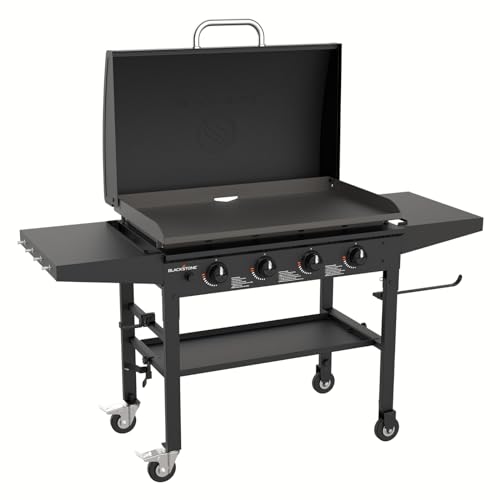
Blackstone vs Weber Slate
The category's defining comparison: bare carbon steel and more heat, against a rust-resistant top that forgives neglect.
Weber Slate vs Traeger Flatrock
Weber's rust-resistant top and three zones against Traeger's insulated zones and higher heat density.
The best rust-resistant griddles
Griddles ranked by how much neglect the cooking surface absorbs: what rust-resistant actually claims, what it costs you in heat, and which parts corrode first.
The best griddle brands
Griddle brands ranked on what a brand actually decides: spare parts in five years, accessory fit, cooktop philosophy, spec-sheet honesty and where you can buy one.
Blackstone griddle alternatives
Six alternatives to a Blackstone, each matched to a specific reason for looking elsewhere: heat, rust, seasoning, price, size or no outdoor space.
Weber Slate 30"
540 square inches, three zones, rust-resistant and pre-seasoned. The strongest pick for people who cook occasionally.